
Why Saturn's Magnetic Field is Weirdly Lopsided (And Why We Should Care)
If you've ever imagined planets as having nice, neat, symmetrical magnetic fields like we see in textbooks, let me introduce you to Saturn — the rebel of our solar system.
Earth Does It Right; Saturn... Does Its Own Thing
Think of a planet's magnetic field like an invisible bubble protecting it from the solar wind — that constant stream of charged particles the Sun hurls through space. Our Earth's magnetic field is pretty well-behaved. It's balanced and symmetrical, like a perfect force field in a sci-fi movie.
Saturn? Not so much.
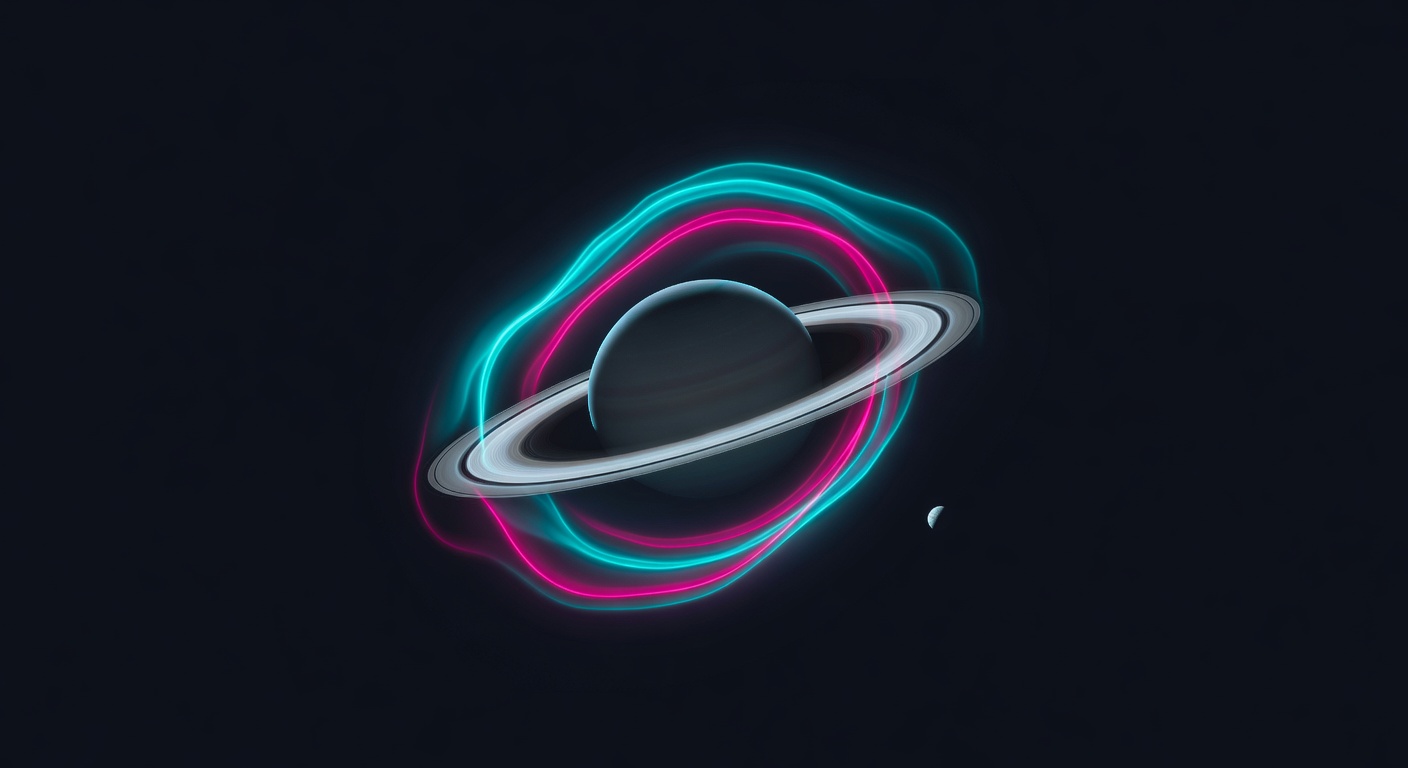
New research from an international team of scientists just figured out that Saturn's magnetic field is noticeably twisted and off to one side. It's like someone took that protective bubble and gave it a hard shove. Using six years of data from NASA's Cassini spacecraft, researchers discovered that the spot where solar wind particles can sneak into Saturn's magnetosphere — called the "cusp" — isn't where you'd expect it to be at all.
The Location That Doesn't Make Sense
Imagine looking at Saturn from the perspective of the Sun. On Earth, that entry point would be roughly at the "12 o'clock" position. On Saturn? It's hanging out somewhere between 1 and 3 o'clock. Every single time scientists checked, it was shifted to the right.
This isn't a measurement error or a fluke. This is consistent, and it's weird.
Two Cosmic Forces Teaming Up
Here's where it gets interesting. Scientists figured out why this happens, and it involves two ingredients working together like an unstoppable team:
First: Saturn spins incredibly fast. We're talking one complete rotation every 10.7 hours. For comparison, Earth takes 24 hours. Imagine a top spinning at warp speed in space.
Second: Saturn is surrounded by a massive cloud of plasma — basically ionized gas. A lot of this stuff comes from Saturn's moon Enceladus, which is constantly releasing water vapor from its underground ocean. This creates a thick, energetic soup swirling around the planet.
When you combine rapid rotation with all that heavy plasma being dragged around, the magnetic field lines get pushed sideways. It's like trying to hold a rope straight while someone's spinning you in circles — the rope bends in ways it normally wouldn't.
Why This Actually Matters
You might be thinking, "Cool science fact, but so what?" Here's the thing: understanding Saturn's magnetic environment is becoming urgent for real reasons.
Enceladus — that moon creating all this plasma — is a big deal. It has a subsurface ocean that might harbor life. The European Space Agency is planning a mission to Saturn and Enceladus for the 2040s, and they need to understand this space environment to safely explore it and search for signs of life.
This research also reveals something fundamental about how planets work. Gas giants with rapid rotation seem to operate by different rules than Earth does. Their moons and internal activity become the dominant force shaping their magnetic environments, rather than the solar wind taking the lead role like it does for us.
A Window Into Alien Worlds
Here's what really gets me excited: this research gives us a blueprint for understanding magnetic fields around exoplanets. When astronomers discover planets around other stars, they can now use these principles to predict how their magnetic fields might behave — something that's crucial for assessing whether those worlds could potentially support life.
Saturn used to seem like this exotic, distant world. Now scientists are realizing it's actually a natural laboratory showing us how planets can work in completely different ways than we assumed. And that changes how we understand our entire universe.
The Cassini spacecraft may have stopped transmitting data years ago, but it's still teaching us incredible things about our solar system. Pretty cool, right?
Source: https://www.sciencedaily.com/releases/2026/04/260403002014.htm