
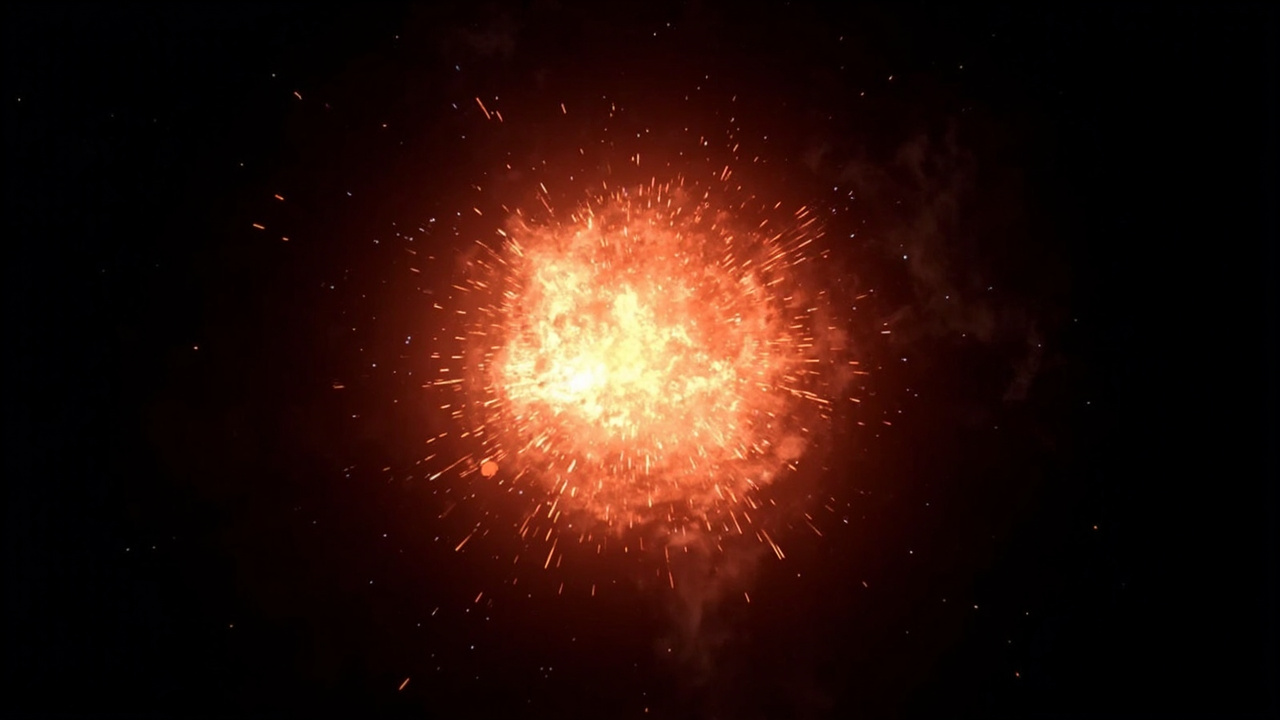
Wait, Nuclear Fireballs? In a Lab?
Okay, I know what you're thinking. "Nuclear fireballs" sounds like something out of a disaster movie, not a research paper. But hold on — before you imagine scientists playing with radioactive materials in some dangerous Frankenstein setup, let me explain what's actually happening.
Scientists at Lawrence Livermore National Laboratory in California have figured out how to create miniature nuclear fireballs in a controlled environment. These aren't the massive, city-leveling explosions you'd see in footage from the 1940s. Think of them more like... extremely hot, carefully contained puffs of vapor that let researchers study what happens when radioactive materials heat up, mix, and eventually cool down into particles.
It's honestly kind of cool when you think about it (pun absolutely intended).
Why Does This Matter? Here's the Thing About Fallout...
Here's something most people don't realize: in a nuclear accident or detonation, the initial explosion isn't always the deadliest part. It's what comes after — the fallout.
When that massive burst of energy releases, it vaporizes everything nearby. But as all that radioactive material cools and condenses, it forms particles that can travel thousands of miles on wind currents before settling back down to Earth. We're talking about particles containing uranium, cesium, and other nasty elements that can contaminate water, soil, and pretty much anything else they touch.
The Chernobyl disaster is a perfect example. While two workers tragically died in the initial explosion, the resulting fallout potentially impacted up to 6 million people. Those radioactive particles didn't just stay in one place — they spread across Europe like an invisible, deadly dust.
The Problem With Current Fallout Models
Here's where things get frustrating. The models scientists currently use to predict how fallout behaves? They're not great. They treat radioactive materials like lonely islands — existing separately from their environment and other elements. But that's not how reality works.
When uranium vapor mingles with cesium vapor and cerium vapor, all sorts of chemical interactions happen during the cooling process. These interactions affect how particles form, how big they get, and where they eventually land. Ignore those interactions, and your predictions become, well, less accurate than we'd like.
And when we're talking about nuclear disasters where millions of lives are at stake, "less accurate" is not exactly reassuring.
The Plasma Flow Reactor: Science's Time Machine
So what did the LLNL team do? They built what they call a plasma flow reactor — basically a specialized tube that can heat materials to extreme temperatures, turning them into plasma, then allow that plasma to cool gradually while the scientists observe the whole process.
Think of it like a high-tech conveyor belt for radioactive vapor. The team can add specific mixtures of elements, crank up the heat, and then watch as the vapor travels through the tube while they collect samples at multiple points along the way. It's like having a time machine that lets them watch condensation happen in slow motion, capturing exactly how particles change and interact as temperatures drop.
The Three Musketeers: Uranium, Cesium, and... Cerium?
The researchers focused on three elements: uranium, cesium, and cerium.
Uranium is the star of the show — it's what typically splits during nuclear fission. Cesium-137 is one of the most common and dangerous byproducts of that splitting process. Both are pretty obvious choices for this kind of research.
But cerium might leave you scratching your head. Why study this particular element?
Here's the clever part: cerium is non-radioactive but chemically and physically behaves similarly to plutonium. Scientists can safely work with it in a regular lab setting while still learning things that apply to actual radioactive scenarios. It's like using a stunt double — same behavior, way less risk.
Two Different Cooling Stories
The team tested two different scenarios. In the first, temperatures dropped continuously along the tube — a steady, gradual cooling. In the second, temperatures stayed elevated for longer before dropping rapidly.
Why does this matter? Because the cooling path significantly affects how particles form and what chemical compounds they create. Historical fallout studies suggested this was important, but now the team has actual measurements to prove it.
And here's what they found: uranium and cerium condensed pretty quickly since they're less volatile. But cesium? It hung around in vapor form much longer, giving it plenty of time to mingle with other materials before eventually condensing.
This timing difference is crucial. It's not just about when an element condenses — it's about what it interacts with during all that time in the vapor phase. Cesium has more opportunities to form compounds and attach to particles that uranium and cerium have already started creating.
Why This Actually Excites Me
Here's my take on why this research matters beyond the science:
We're living in a world where nuclear energy is making a comeback as we search for cleaner power sources. We're also living in a world where nuclear threats feel increasingly real. Whether it's a power plant accident like Fukushima or something far worse, having better models to predict fallout patterns could quite literally be the difference between thousands and millions of affected people.
These researchers aren't trying to create bigger bombs or advance nuclear weapons technology. They're trying to understand the aftermath — so that when (not if, unfortunately) the next nuclear incident happens, emergency responders and policymakers have better information to protect communities.
The lead researcher, Raksa Dhaoui, put it well: these particles preserve a record of how they formed. By replacing assumptions with actual measurements, they can improve the models used to interpret nuclear debris and support decision-making when it matters most.
That's not science fiction. That's science saving lives.
What's Next?
This study establishes baseline measurements for tracking how these elements behave, but the team hopes to expand their research to include more common elements found in real nuclear scenarios. Eventually, this could bring us closer to analyzing potential fallout effects in a laboratory setting — essentially giving us a crystal ball for nuclear disasters, even if that crystal ball is currently still a work in progress.
So the next time you hear about nuclear research in the news and it sounds scary or secretive, remember this story. Sometimes scientists creating "nuclear fireballs" isn't about destruction — it's about understanding something so well that we can better protect ourselves from it.
And honestly? I find that pretty reassuring.
Source: https://www.popularmechanics.com/science/a71549430/nuclear-fireball