
Markdown formatted blog content
The Universe's Most Confusing Red Dots
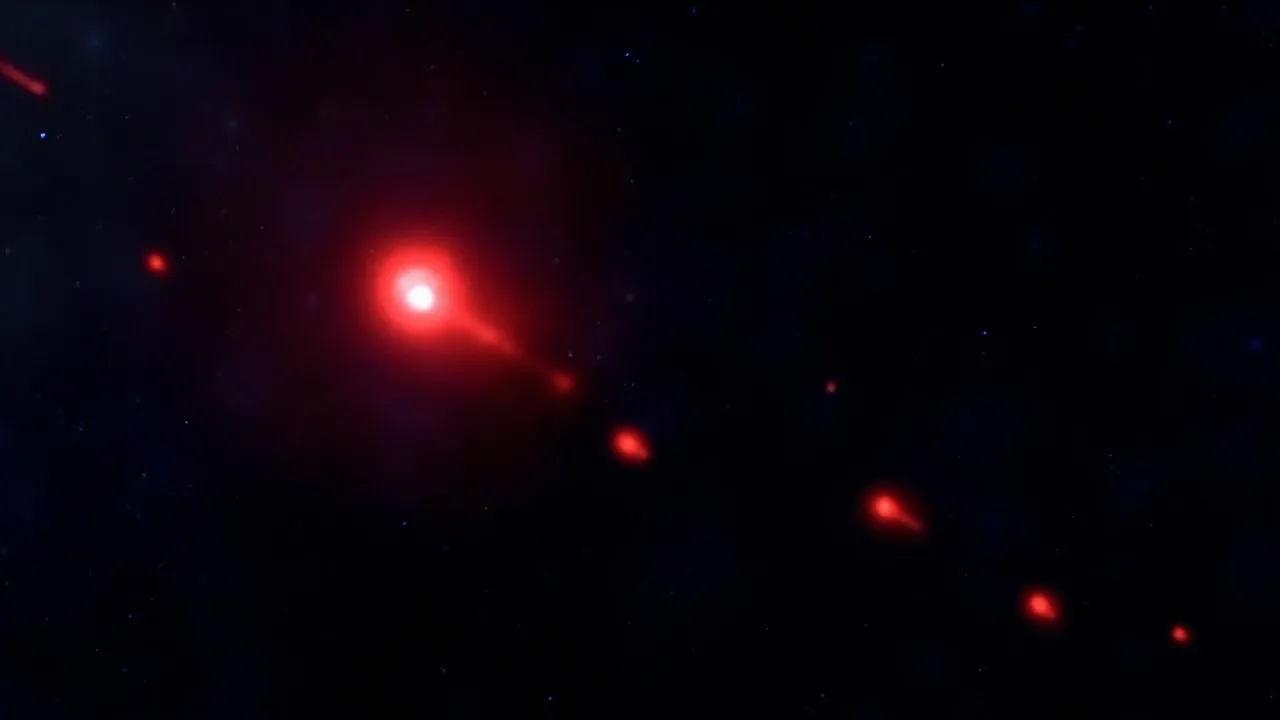
Okay, picture this: You're an astronomer with the most powerful telescope ever built, pointing it at the distant universe, and suddenly you see thousands of tiny red dots everywhere. What are they? How did they form? And here's the really weird question — what happened to them?
That's exactly what happened when the James Webb Space Telescope (affectionately called "Webb" by astronomers) started sending back its first images back in 2022. These little red dots, or LRDs as scientists call them, appeared throughout the early universe, glowing in shades of ruby and crimson. And honestly? They've been driving astronomers a little bit crazy ever since.
Here's the puzzle: These little red dots are super common in the distant, early universe. But as you look closer to home — at galaxies that formed more recently — they basically disappear. So either they've somehow vanished, evolved into something unrecognizable, or we've just been looking at them wrong this whole time.
A Cactus-Shaped Clue
This is where things get interesting. A team of researchers led by Pierluigi Rinaldi may have found what little red dots transform into. And honestly, the story is almost as wild as the mystery itself.
The team discovered a spiral galaxy nicknamed the "Saguaro" (named after the iconic cactus found in the American Southwest) because its spiral arms stretch out like — you guessed it — a cactus. This galaxy sits at a distance that means we're seeing it as it was roughly 3.3 billion years after the Big Bang. Not exactly recent, but not impossibly far either.
At the heart of the Saguaro sits a compact, bright red source that looks suspiciously like those mysterious little red dots we see in the distant universe. But here's the cool part: because this galaxy is closer to us, we can actually see its full structure — not just the blazing core.
The Great Cosmic Illusion?
So what's the breakthrough here? The researchers suggest that little red dots might not be some weird, separate category of cosmic object after all. Instead, what we're seeing could be partly an illusion.
Think of it this way: when you look at an extremely distant galaxy, the surrounding structures — the spiral arms, the outer regions, the dust clouds — become too faint for even Webb to pick up. You're basically seeing just the super-bright center, like staring at a distant city and only being able to see the glow of the central skyscrapers against the darkness.
In other words, we might have been fooled by distance itself.
The Black Hole Connection
But here's where it gets really fascinating. The team confirmed that the Saguaro's compact red center isn't just a regular patch of stars — it houses an active supermassive black hole, known to scientists as an active galactic nucleus. These black holes guzzle nearby material and blast out incredible amounts of energy.
The Saguaro also produces weak X-ray emissions, which confirms it has one of these hungry black holes at its heart. The X-ray signal is obscured and relatively gentle, which might explain why similar signals are hard to detect from the distant little red dots.
"We're finally seeing what these things become," said George Rieke of the University of Arizona. And honestly? That feels like a pretty big deal.
Why This Matters
Here's the thing about astronomy that I find genuinely beautiful: we're essentially doing detective work on a crime scene that happened billions of years ago. Every clue helps us piece together the story of how our universe evolved from a hot, dense point into the mind-bogglingly vast cosmic neighborhood we live in today.
These little red dots were one of Webb's first big surprises, and they reminded scientists that the universe still has plenty of secrets to keep. Now, thanks to this new research, we have a better understanding of how galaxies — and the black holes at their hearts — grow and change over cosmic time.
The Saguaro might just be one galaxy, but it could be the key to understanding thousands of those ruby-red specks scattered across the early universe. And personally, I think there's something wonderfully poetic about a cactus-shaped galaxy helping us solve one of space's newest mysteries.
The universe has a quirky sense of humor, doesn't it?