
The Ultimate Long Game
Imagine being told you have an incurable disease. The doctor's words are final. There's no cure. But then someone offers you a different option: what if you didn't have to accept that verdict? What if you could hit pause on death itself and wait for future medicine to catch up?
This isn't the plot of a sci-fi movie. It's happening right now, and it's called cryonics.
From Whole Bodies to Just Brains
For decades, cryonics companies preserved entire bodies in liquid nitrogen—a sort of biological time capsule. But here's what's changing: more people are choosing to preserve just their brains.
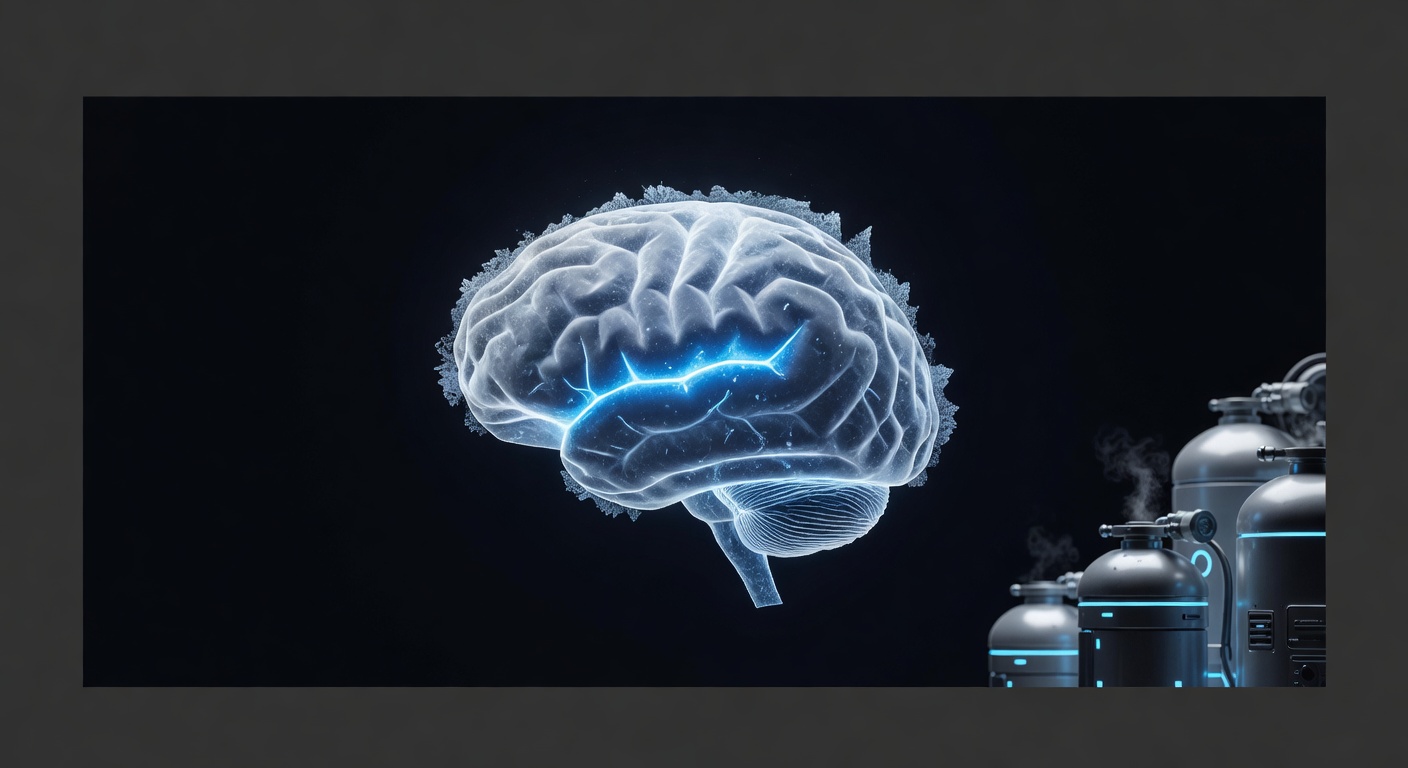
Why? Because it's faster, cheaper, and honestly, way easier to store. Think about it—a whole body takes up a lot of space and requires more complicated procedures. A brain? You can fit that in a silver container the size of a desk lamp.
The shift started gaining momentum when researchers realized something: if you're going to wake someone up in 200 years with super-advanced technology, do they really need their original body? Future scientists could theoretically clone a new body, create a synthetic one, or even build a virtual reality vessel for the consciousness to inhabit.
Here's the Creepy Part (Sorry, Not Sorry)
Dr. Stephen Coles, a UCLA aging researcher, was one of the first to go this route back in 2014. When he died of pancreatic cancer, a specialized team showed up at his bedside in Arizona. They used a mechanical CPR device to keep his blood flowing, pumped his veins full of medical antifreeze, cooled him down, and then—this is the part that sounds like horror movie material—they removed his head.
His brain was in a frozen container by dinnertime.
Now, ten years later, this procedure that seemed shocking and experimental is becoming routine. Companies are getting better at it, the process is streamlining, and more people are signing up.
But Wait... Would You Still Be You?
Here's where things get philosophically bonkers, and honestly, it's the question that keeps me up at night.
If a future civilization manages to revive your frozen brain and put it in a new body (or a digital simulation), will that actually be you? Or will it be some copy of you, while the real you is just... gone?
This is the kind of question that makes philosophers and neuroscientists argue for hours. Are you your consciousness, your memories, your body, or some combination of all three? If scientists could reconstruct every single neuron perfectly, would that be you coming back to life, or would it be creating a new person who just thinks they're you?
I don't have the answer. Honestly, I'm not sure anyone does.
The Antifreeze Problem
One thing that's definitely true: we're not actually "freezing" these brains the way you'd freeze a pizza. That would destroy them.
Here's why: your body is about 70% water. If you just threw a corpse in a freezer, ice crystals would form inside the cells and shatter them like tiny ice picks. When you thawed it out later, you'd have brain mush.
Instead, cryonics uses vitrification. Scientists replace all the blood with a medical-grade antifreeze called a cryoprotectant, then gradually cool everything down until it reaches a glass-like state at -140 degrees Celsius. At that temperature, all biological processes essentially stop. It's preservation without the cellular destruction.
Pretty clever, right?
The Big Unspoken Assumption
Here's what's wild about cryonics: it's betting on technology that doesn't exist yet. No human brain has ever been revived after cryopreservation. Not one.
The entire premise rests on the assumption that someday—maybe in 50 years, maybe in 500—we'll develop the technology to:
- Fix whatever killed you in the first place
- Repair any cellular damage from the preservation process
- Figure out how to revive a frozen brain without destroying it
- Somehow restore consciousness and identity
That's a lot of assumptions.
Why People Do This Anyway
Emil Kendziorra, a German medical doctor turned cryonics advocate, puts it simply: he couldn't accept telling young patients with incurable diseases that they just had to die. He thinks everyone should have the right to live as long as they want to.
And you know what? He has a point about the skepticism. Heart transplants seemed impossible once too. In vitro fertilization was considered science fiction. People once thought organ transplantation between bodies was absolutely insane.
Just because something sounds impossible now doesn't mean it will be impossible forever.
The Real Gamble
Cryonics isn't really about science—not yet, anyway. It's about hope and philosophy and the human refusal to accept mortality.
Some people think it's beautiful. Some think it's delusional. Some think it's the ultimate expression of human stubbornness.
What I find interesting is that it forces us to ask uncomfortable questions: What actually makes you you? Can consciousness be preserved and restored? Should we pursue immortality if we could?
Whether cryonics ever works is still a giant "we'll see." But the fact that people are doing it anyway? That tells you something about how much we fear death, and how far we'll go to dodge it.
Maybe that's the most human thing of all.