
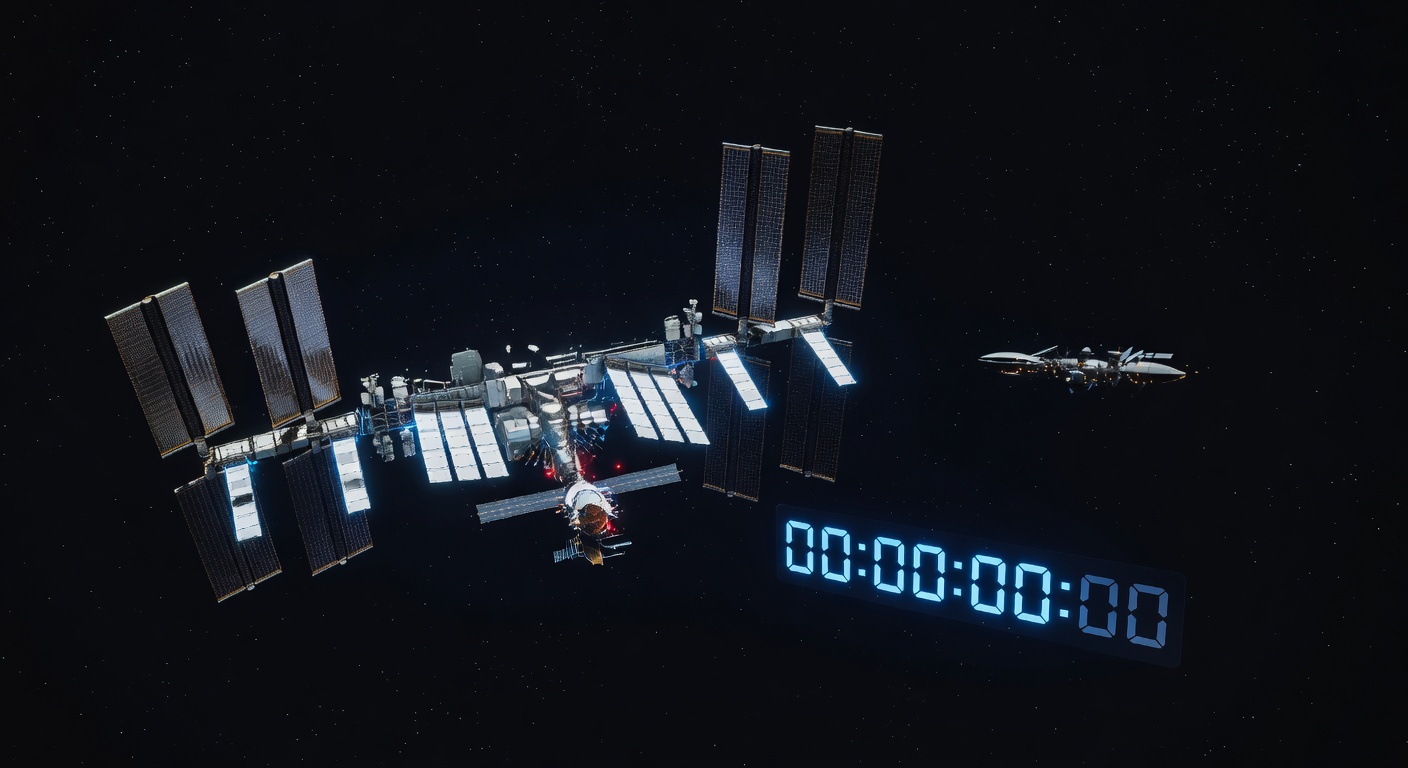
The Clock Is Ticking for Our Home in Space
Hey space enthusiasts! Let's talk about something that's been keeping NASA engineers up at night – and honestly, it should concern all of us who dream of humanity's future beyond Earth.
The International Space Station isn't just getting old; it's getting dangerously old. And the worst-case scenarios floating around mission control are pretty sobering.
When "Space-Age" Technology Shows Its Age
Here's the thing that blows my mind: the ISS has been continuously occupied since November 2000. That means some of the technology up there is older than TikTok, older than the iPhone, heck – older than YouTube. We're talking about hardware that was cutting-edge when dial-up internet was still a thing.
But unlike your old laptop that just runs slowly, when space station components fail, the consequences are life-or-death serious.
The Nightmare Scenarios Nobody Wants to Talk About
The absolute worst thing that could happen? A catastrophic structural failure that forces an emergency evacuation. Picture this: you're 250 miles above Earth, and suddenly the station's hull develops a major breach, or a critical life support system fails beyond repair.
The crew would have to scramble into their Soyuz or Dragon capsules and abandon humanity's most expensive construction project – possibly forever. All that research, all those experiments, all that international cooperation – gone in a matter of hours.
It's Not Just About Hardware
What really gets to me is that the ISS represents something bigger than just scientific achievement. It's proof that when we want to, humans can work together on something incredible. Russian cosmonauts and American astronauts sharing meals and conducting experiments side by side, even when their governments are at odds down here on Earth.
But political tensions are making the station's future even more uncertain. International partnerships that took decades to build could unravel faster than we think.
The Race Against Time
NASA knows the writing is on the wall. They're planning to deorbit the ISS sometime in the 2030s – but that assumes everything goes according to plan. The reality is that aging systems could force their hand much sooner.
The good news? Private companies like Axiom Space and Blue Origin are working on commercial space stations to fill the gap. But there's still a very real possibility of a period where we have no permanent human presence in space for the first time in over two decades.
What This Means for All of Us
I know it might seem like this is just a problem for astronauts and space nerds like me, but losing the ISS would be a massive step backward for humanity. All those medical breakthroughs, climate research, and technological innovations that come from microgravity experiments? That pipeline could dry up.
More importantly, the ISS serves as a stepping stone to bigger things – Moon bases, Mars missions, deep space exploration. Without it, we lose our training ground for living and working in space.
The Silver Lining
Despite all these concerns, I'm cautiously optimistic. The space industry today is more dynamic and innovative than ever before. While losing the ISS would be heartbreaking, it might also push us to build something even better.
The key is making sure we don't have a gap in our space presence. Because once we step back from space, history shows it's incredibly hard – and expensive – to get back up there.
What do you think? Are you worried about the ISS's future, or excited about what might replace it? Let me know in the comments!