
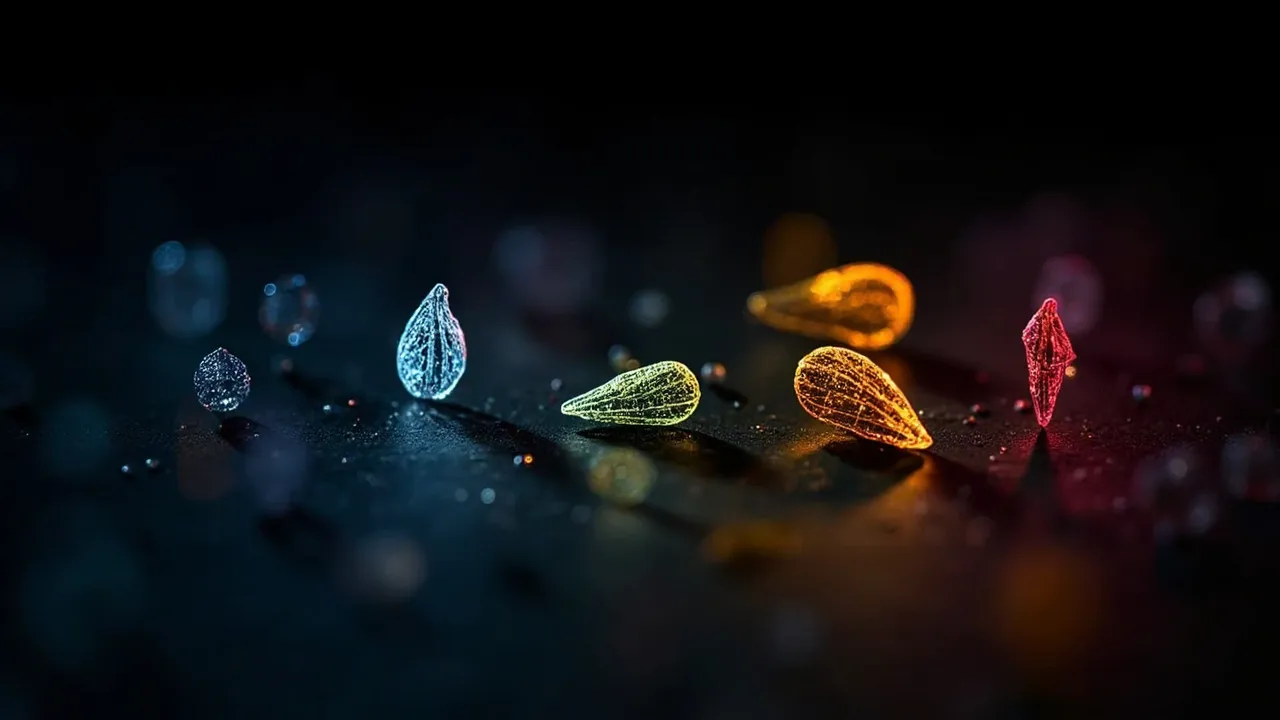
The Oldest Family Album You've Ever Seen
Here's something wild to think about: for about 90% of Earth's history, our planet was basically one giant petri dish. Microscopic bacteria ruled supreme, and the concept of "visible life" was absolutely nowhere on the horizon.
Then something remarkable happened. Those tiny microbes eventually gave rise to eukaryotes—cells with a proper nucleus and energy-producing mitochondria. And those eukaryotes? They're the ancestors of literally everything you can see and touch: your cat, your houseplants, the mushrooms in your fridge, and of course, you.
But here's the puzzle that has scientists scratching their heads: when exactly did this monumental shift happen? And how did it unfold?
What Even Is a Eukaryote? (And Why Should You Care?)
Let me break this down in the simplest terms possible.
You know how your house has different rooms with different purposes? A kitchen for cooking, a bedroom for sleeping, and so on? Eukaryotic cells work kind of the same way. They have specialized structures called organelles that handle different jobs.
The most important of these is the mitochondrion—often called the "powerhouse of the cell." This little structure produces the energy that allows cells to do much more demanding work. It's why you can have cells that form muscles, nerves, and entire organs instead of just floating around as lonely, simple blobs.
Every plant, animal, and fungus on Earth today is built from these eukaryotic cells. We're literally walking temples of cellular complexity, all thanks to a transition that happened billions of years ago.
The Problem With Ancient Life
Here's where things get frustrating for paleontologists.
Before about 500 million years ago, organisms hadn't yet evolved shells or bones. They were soft, squishy, and decomposes into oblivion pretty easily. Unlike dinosaur bones or ancient shells, these early life forms left almost no trace.
Think about it—how would you preserve a jellyfish for 1.7 billion years? That's a nearly impossible task, which is why scientists have relatively few clues about what happened during that enormous stretch of Earth's history.
One researcher, Ross Anderson from the University of Oxford, has made it his mission to piece together this biological puzzle. His work involves studying the chemistry of ancient rocks to identify environments where delicate biological material might have survived.
Where on Earth Do You Even Look?
This is where the story gets interesting.
Anderson and his colleagues have focused their search on some of the most remote places on our planet. One particularly promising area? Svalbard, Norway—an Arctic archipelago sitting at about 80 degrees North latitude.
This region was once covered by a shallow sea, and the conditions there may have been just right for preserving ancient eukaryotic remains. The enormous deposits of clay in these areas could have acted like nature's time capsule, protecting fragile cells from billions of years of geological wear and tear.
Australia has also yielded remarkable discoveries. Just last year, researchers found what might be some of the oldest known eukaryotic microfossils, dating back roughly 1.75 billion years.
The pattern? Ancient coastal environments seem to be the goldmine. Eukaryotes living in these areas would have had access to abundant nutrients and organic material—exactly the conditions that could support greater diversity and the development of multicellular life.
Why Does Any of This Matter?
You might be wondering—okay, cool science history lesson, but why should I care about 1.7-billion-year-old microfossils?
Here's why this research genuinely matters:
First, understanding how complex life emerged on Earth helps us appreciate just how remarkable and improbable our existence is. Those bacteria that dominated early Earth had the planet to themselves for billions of years. The fact that anything more complex ever developed is genuinely extraordinary.
Second, this knowledge directly informs our search for life elsewhere in the universe. If complex life is incredibly rare because it requires such specific conditions and such enormous amounts of time, that tells us something profound about our cosmic loneliness—or lack thereof.
Third, it's a reminder that life is constantly changing and adapting. The organisms on Earth today are the result of an unbroken chain of survival and evolution stretching back over 3.5 billion years. You're connected to every single one of those ancient microbes in a very literal, genetic sense.
The Hunt Continues
Scientists still don't have all the answers. The transition from single-celled eukaryotes to multicellular organisms happened more than once in different parts of the world, and researchers like Anderson are working to understand how those various paths eventually converged into the remarkable diversity we see today.
Much of the foundation for modern animal diversity emerged around 540 million years ago during the Ediacaran-Cambrian transition—a period that saw soft-bodied organisms give way to the famous "Cambrian explosion" that produced shelled creatures, mobile animals, and fundamentally changed the character of life on Earth.
Every new fossil discovery, every ancient rock analyzed, adds another piece to this grand biological puzzle. And who knows? The next breakthrough might come from someone peering through a microscope at a sample from a frozen Arctic rockpile or an Australian outback.
In the meantime, the next time you see a bird outside your window, a tree in your neighborhood, or even a mushroom pushing up through the sidewalk, take a moment to appreciate the absolutely incredible cellular machinery that makes them possible—all thanks to a transition that happened billions of years ago in a world very different from our own.