
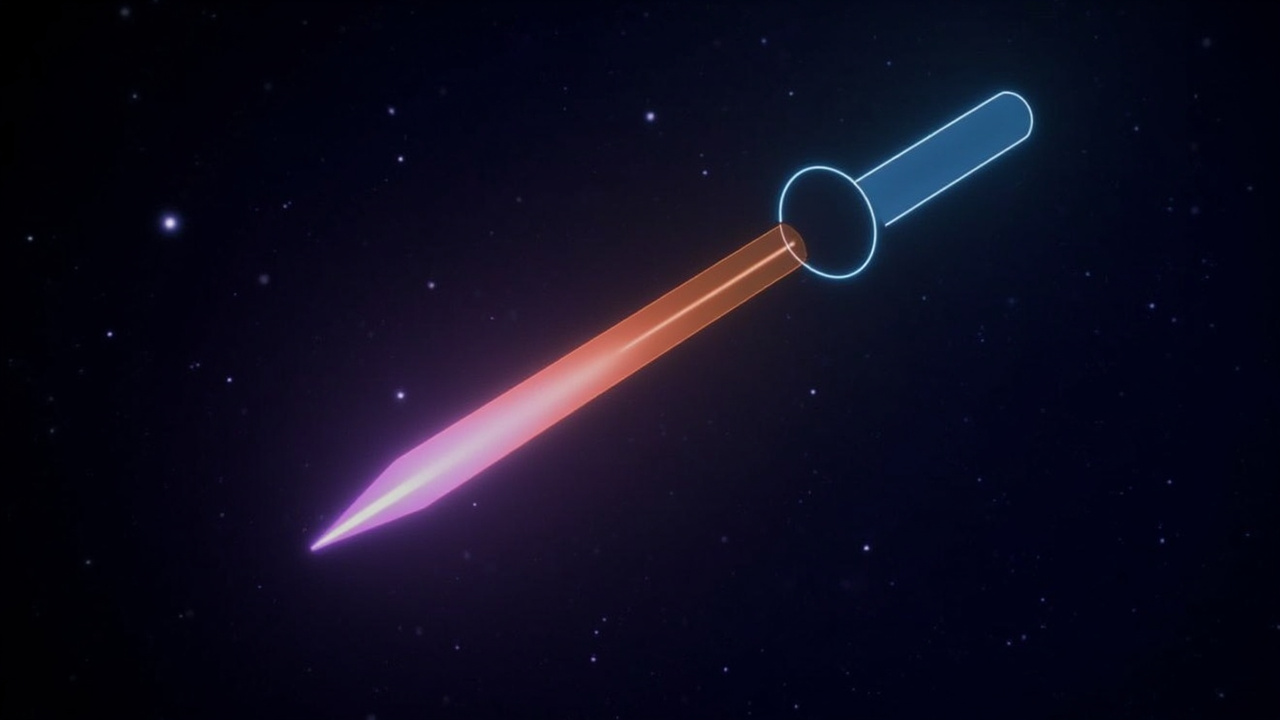
So there's this Harvard professor who's been on Joe Rogan, has a NASCAR race car with his face on it, and was just appointed by the Trump administration to advise on UFO policy. And oh yeah—he thinks that weird asteroid thing floating through our solar system might be alien technology.
I'm talking about Avi Loeb, and honestly? His story is absolutely wild.
Avi Loeb is antsy. He is sitting in his office at the Harvard Smithsonian Center for Astrophysics, waiting to be interviewed on a midday Newsmax program. He did not prepare for the QA; there are no notes to keep him on message. He doesn't check the vast whiteboard speckled with formulas across the room or even a mirror to assess his short, neatly combed, brown-but-graying hair. Moments earlier, he simply shrugged on his navy suit jacket over a lavender button-down and pointed me toward the ancient burnt-orange sofa next to his desk. Then he sits, streams the show on his computer, and waits.
Five minutes pass, then 10, as the hosts riff on welfare fraud and other conservative causes célèbres—what Loeb thinks of, in his post-partisan way, as terrestrial matters. As it becomes clear he'll be running late to the weekly luncheon of the Institute for Theory and Computation, which he leads, he shifts in his seat, begins to fidget. The producer pops on to assure him they're almost ready to go.
"Okay," Loeb replies, with a serrated edge of testiness, "but in five minutes, I'll have 100 people waiting for me."
Most academics would reshuffle their week for the chance to shill their research on a national news show. But Loeb has been doing interviews all week—an average of eight per day, he says—because of his take on 3I/ATLAS, an interstellar object that has captured public fascination. (The "3I" indicates that it's the third known interstellar object to pass through our celestial backyard; ATLAS is an acronym for "Asteroid Terrestrial-impact Last Alert System," the Chile-based telescope network that first detected it.) The astronomy community generally agrees it's a comet—potentially the oldest one ever seen. But Loeb, while conceding this is likely true, has repeatedly pointed to what he contends are unexplained anomalies that raise the possibility of a projectile sent by an intelligent life form from elsewhere in the universe.
Over the past eight years, Loeb has gained worldwide notoriety for advancing such provocative notions, propelling him ever deeper into the pop-culture zeitgeist. Three weeks before this interview, he'd flown to a NASCAR event in California in which a race car, emblazoned with Loeb's face, was dedicated to the interstellar object. Earlier in 2025, he landed on the front page of The New York Times as part of a story about NASA and Kim Kardashian's fascination with 3I/ATLAS. A recent Loeb appearance on The Joe Rogan Experience racked up a combined audience of 6.4 million on Spotify and YouTube. And just last month, the Trump Administration appointed Loeb to lead a scientific advisory council that will study the national security risks of UFOs—or unidentified aerial phenomena, in government parlance.
When the interview finally begins, the host, eager for a spicy take, plays a clip from then-acting NASA Administrator Sean Duffy saying that scientists have concluded that 3I/ATLAS is definitely a comet. "How do you respond to that, Dr. Loeb?"
He is coiled to unload. "Oh, very simply, the foundation of science is the humility to learn, not the arrogance of expertise," he says. "It doesn't make sense to say, 'The experts say,' and therefore you should believe it. It makes sense to say, 'Here is the evidence, and it's a comet beyond a reasonable doubt because of this and that piece of evidence.' However, there are all these anomalies about this object, and we still haven't figured out what it is."
In July 2025, when 3I/ATLAS was first spotted more than 400 million miles from the sun, the object was already enveloped in a cloud of dust and gas, which makes it distinct from the typical dark and inert state of most comets at that distance. Its trajectory also has varied from that of an object pulled by the sun's gravity alone, and it possesses much more carbon dioxide than most solar system comets, as well as high levels of nickel. And as 3I/ATLAS made its closest approach to the sun in October, it brightened and shifted hues, adding blue-green colors. Loeb concludes the six-minute segment by inveighing against the likes of Duffy, who he says pose a danger to science. Then he smiles, thanks the host, and bounds up from his desk. "Let's go," he says. "The people are waiting."
And he's off, racewalking down the labyrinthine halls of the esteemed Harvard edifice. I briefly pause to organize myself, which is a mistake; he vanishes so quickly I end up having to ask for directions. It's fitting: Loeb is careening forward with his unusual career pivot at such a furious pace that it's impossible for anyone—even him—to know where this will all end up.
Two bronze busts of Galileo were among the first things I'd noticed upon entering Loeb's office for the first time. It's tempting to infer in this placement an unsubtle attempt to entwine his narrative with that of the iconic trailblazer. Galileo was famously jailed for his unorthodox and heretical ideas—and, of course, was ultimately vindicated. Appearances
My Take: Is This Guy Crazy or a Genius?
Here's the thing about Avi Loeb—he's impossible to ignore, and that's exactly what makes him so interesting.
Most scientists spend their careers publishing papers that maybe a hundred people read and hoping for a promotion. Loeb has somehow managed to become a pop culture figure while still holding down a position at one of the most prestigious institutions on Earth. That takes some serious chutzpah.
Now, let's talk about the actual science. Is 3I/ATLAS an alien artifact? Almost certainly not. Most astronomers think it's just an old comet, and that's probably the right call. But here's what I appreciate about Loeb: he's asking questions that a lot of scientists are too scared to ask out loud.
What are those anomalies he keeps pointing to? The object was already releasing gas and dust when it was first spotted, way farther from the sun than comets usually start doing that. Its trajectory has some weird variations. It has unusual chemical signatures. None of this proves anything artificial, but it's worth asking "what if," right?
The scientific community's typical response to Loeb ranges from eye-rolling to outright hostility. They call him attention-seeking, say he's giving science a bad name. And honestly, I get it—there's something uncomfortable about a Harvard professor going on Joe Rogan to talk about aliens when he should be doing, you know, actual research.
But then again... why shouldn't we consider the possibility that we're not alone? The universe is impossibly vast. We've only been looking for signs of extraterrestrial intelligence for a few decades. Acting like we've got it all figured out seems pretty arrogant, doesn't it?
Loeb's whole schtick is that science has become too afraid to ask bold questions. He says "the foundation of science is the humility to learn, not the arrogance of expertise." That's either profound wisdom or a convenient excuse for saying provocative things without proof. Probably a bit of both.
What's fascinating is watching how he's navigated this space between serious academia and pop-culture provocateur. He got appointed to a government UFO advisory council. NASCAR fans know his face. Kim Kardashian tweeted about his work. How many astrophysicists can say that?
The Real Question
Here's what I keep coming back to: does it matter if Loeb is right?
If 3I/ATLAS turns out to be just an unusual comet, Loeb looks like a guy who chased attention and got a little too excited about nothing. But even in that scenario, he got people talking about space, about the possibility of life beyond Earth, about why we should keep looking up.
And if—big if—he's onto something? If that weird object really is a probe sent by some distant civilization? That would be one of the most important discoveries in human history, and this combed, lavender-shirt-wearing, racewalking Harvard professor saw it coming when everyone else was too stuck in conventional thinking to look.
I'm not ready to call Loeb a prophet. But I'm also not ready to dismiss him. The best scientists ask questions that make other scientists uncomfortable. Whether Loeb is brave or just full of himself, he's definitely making us ask better questions.
And honestly? In a world where most of us are just trying to get through the day, there's something kind of inspiring about a guy who really, genuinely believes we might not be alone in the universe—and isn't afraid to say it out loud.
What Do You Think?
Is Avi Loeb a visionary pushing the boundaries of science, or is he an attention-seeker who's gone off the deep end? Either way, I think we can all agree that having a race car with his face on it is objectively hilarious.
Drop your thoughts below. And hey, if aliens are reading this—hi! Welcome to Earth. You'll love it here. The coffee's great.
Source: https://www.popularmechanics.com/space/deep-space/a71626751/avi-loeb-interstellar-objects