
The Nuclear Plot Twist Nobody Saw Coming
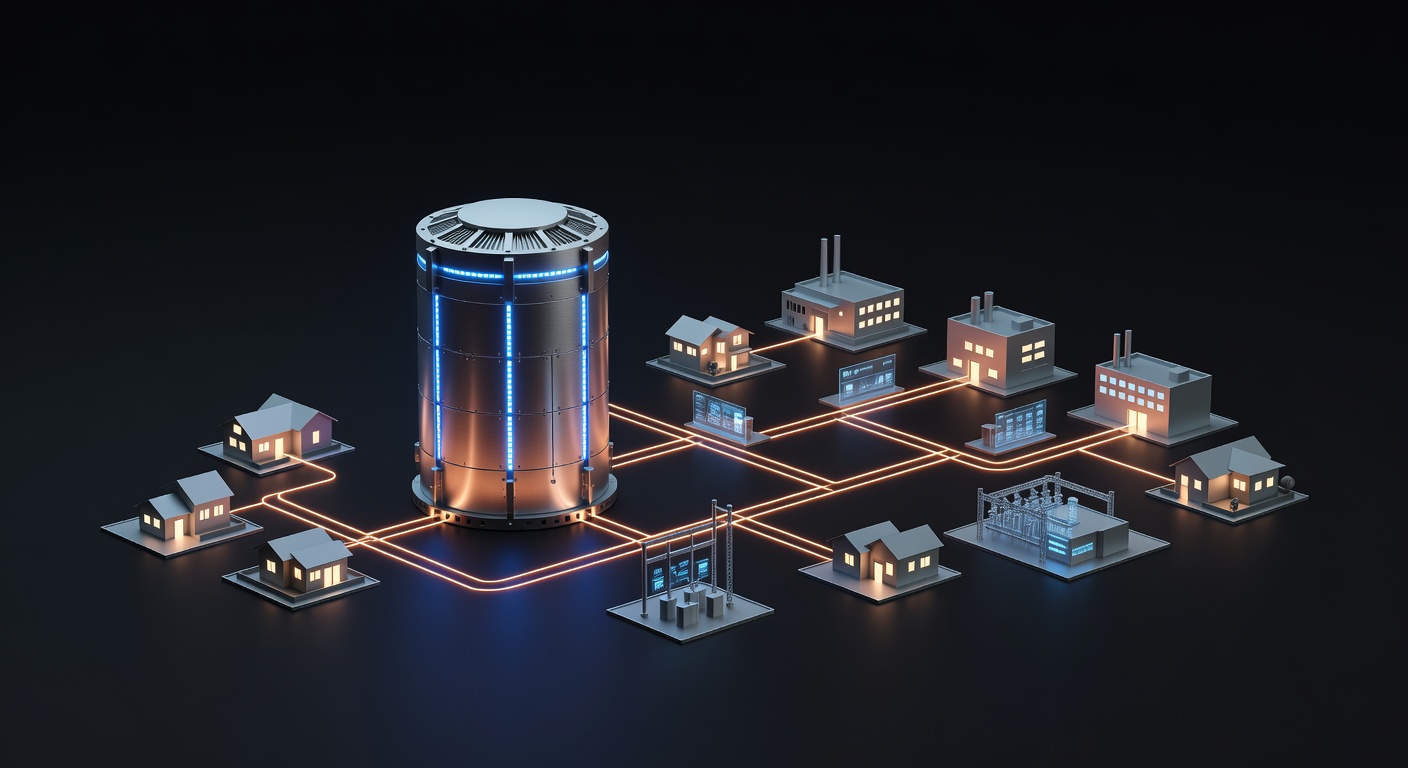
Let me paint you a picture: It's 2024, and the biggest energy innovation isn't a solar panel or a wind turbine. It's a reactor so small it could fit in your backyard (though, you know, don't actually put one there).
I know what you're thinking—nuclear? Isn't that the thing we're supposed to be worried about? Fair point. But here's the plot twist: some brilliant engineers have figured out how to make nuclear energy actually work for regular communities instead of just massive industrial complexes.
The Size Problem Nobody Wanted to Admit
For decades, nuclear power has operated on one principle: go big or go home. We built enormous reactors because, well, that's what we knew how to do. But here's what nobody really talked about—those massive plants are overkill for most communities.
Think about it. A traditional nuclear plant produces about 600 megawatts of power and requires an absolutely massive containment structure. Meanwhile, smaller cities and remote areas don't need that much juice. They were either stuck burning fossil fuels or paying premium prices to buy power from somewhere else.
The new generation of small modular reactors (SMRs) completely flip the script. We're talking about reactors that produce just 10% of a traditional plant's power... but occupy only 1% of the space. That's not just incremental improvement—that's a completely different approach to nuclear energy.
Why "Smaller" Actually Means "Smarter"
Here's what fascinates me about this technology: smaller doesn't just mean less powerful. It means fundamentally safer and more adaptable.
The Safety Angle
Traditional nuclear plants require a 10-mile safety buffer zone around them. SMRs? They can operate in much tighter quarters. Some designs use what engineers call "passive safety systems"—basically, they rely on physics itself (gravity, buoyancy, that kind of thing) to prevent disasters instead of crossing their fingers and hoping mechanical equipment doesn't fail.
One company, Ultra Safe Nuclear Corporation, is taking this even further with fuel that's designed not to melt down. I'll admit, when I first read that claim, I was skeptical. But the physics checks out: they're using specially coated uranium particles that operate at much lower power densities than traditional reactor fuel. Think of it like choosing a nice cruise over an aggressive power drive—it's inherently safer.
The Flexibility Factor
Here's something that really clicks for me: these reactors can actually flex. During the day when solar is pumping out energy, an SMR can dial back to 20% capacity. At night when renewables drop off? Crank it up to 100%.
This is the missing piece nobody wants to admit about renewable energy. Solar and wind are amazing, but they're moody. They don't produce power on your schedule. SMRs can sit there like a reliable backup dancer, filling in the gaps without making a fuss.
The Companies Actually Making This Happen
NuScale is probably the most recognizable name in the SMR space. They're taking the conservative approach—basically taking traditional light-water reactor design and making it smaller, simpler, and more manufacturable. Their reactors are hitting about 60 megawatts each, which is still tiny compared to traditional plants but actually meaningful for real communities.
What I like about NuScale's approach is they're not trying to reinvent the wheel. They're simplifying what we already know works. No fancy external pumps, simpler steam generators, easier maintenance. It's engineering that respects physics without chasing perfection.
Ultra Safe Nuclear Corporation is the wild card here. They're saying, "What if we fundamentally changed the fuel itself?" Their Fully Ceramic Micro-Encapsulated (FCM) fuel wraps uranium in ceramic coatings that protect it while still conducting heat efficiently. It's a totally different philosophy—designing a reactor that can't melt down by physics, not by hope.
The Real World Problem These Actually Solve
Let me be real with you: remote towns, military bases, industrial facilities with heavy power needs, disaster recovery zones—these places have limited options right now. Either build a massive traditional plant (which is economically insane), or keep buying power from somewhere else at premium prices.
SMRs could actually change that math. A town of 10,000 people could theoretically have a single module generating just enough reliable, clean power without the massive capital investment. More modules could be added as the community grows. It's modular. It scales.
The Elephant in the Room: Trust
Look, I'm not going to pretend nuclear's reputation problem is solved by engineering alone. Chernobyl, Fukushima, Three Mile Island—these are real events that shaped how people feel about nuclear power. That psychological weight isn't something a great design document can fix.
But here's my take: we're at a point where climate change is the bigger risk than a well-designed, properly regulated SMR. And unlike large nuclear plants that inspire fear just by existing, smaller reactors might actually be easier for communities to understand and accept. They don't feel like something from a sci-fi disaster movie. They feel like infrastructure.
What Actually Comes Next?
We're in the early stages here. NuScale and others are working on regulatory approval. Universities like the University of Illinois are building their own demonstration reactors. The Department of Energy is throwing support behind these projects.
It's not like we're going to wake up tomorrow and have SMRs everywhere. This is a 5-10 year timeline before we see real deployment. But the momentum is genuinely there.
My Two Cents
I think the most interesting thing about SMRs isn't the technology itself—it's what it represents. It's nuclear energy finally admitting that one-size-fits-all was never actually a good strategy. It's recognizing that power grids don't need to be monoliths, and that redundancy and flexibility might be more important than raw capacity.
If these reactors work as advertised, they could be genuinely transformative for rural electrification, industrial decarbonization, and backup power reliability. Not as a replacement for renewables, but as a true partner in a diversified clean energy future.
Plus, there's something kind of elegant about the idea of a power plant small enough to mass-manufacture but substantial enough to actually matter. It's the opposite of "if you're going nuclear, go huge or go home." It's saying you can be nuclear and neighborly at the same time.
And honestly? In 2024, I'll take that kind of optimism wherever I can find it.
SOURCE: https://www.popularmechanics.com/science/a70846059/tiny-nuclear-reactors-save-energy