
The Wi-Fi Problem Nobody's Talking About
Let's be honest: Wi-Fi has been amazing. It freed us from cables, made working from home possible, and basically changed everything about how we connect. But here's the thing—it's starting to buckle under pressure.
Think about it. You're video calling while your roommate streams Netflix, someone's downloading files, the smart fridge is doing its thing, and you've got a dozen other devices all competing for the same invisible radio waves. It's like trying to have 50 conversations in the same crowded room. Eventually, somebody can't hear.
Radio waves—which Wi-Fi uses—have limited space on the electromagnetic spectrum. There's only so much room to work with, and we're running out. Plus, all that data flying through the air takes energy. Lots of it.
Enter: Light-Based Internet
Scientists just published research about something that sounds like science fiction but is actually happening in labs right now: using lasers to send data wirelessly, just like Wi-Fi, except the signal is made of light instead of radio waves.
I know what you're thinking—"Lasers? That sounds dangerous and impractical." But stay with me. These aren't the lasers from action movies. They're tiny infrared lasers, the same kind already used in data centers and high-tech sensors. They're safe, efficient, and incredibly fast.
The Brilliant Part (Literally)
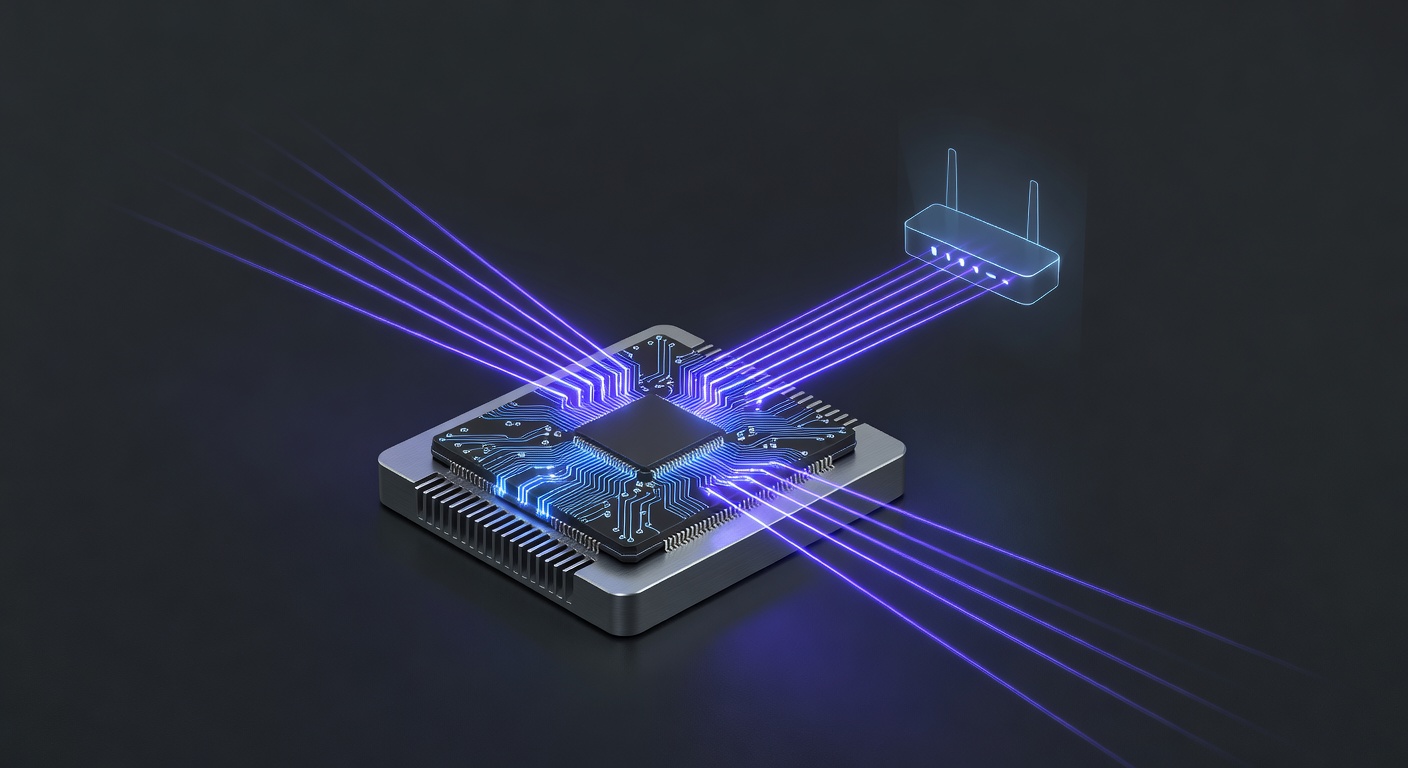
The researchers built something clever: a chip barely larger than a grain of rice packed with 25 tiny lasers arranged in a grid. Imagine a small flashlight, but instead of one bright beam, it can shoot 25 individual streams of light, each carrying its own data.
Here's where it gets interesting. Each laser works independently, so you can use multiple beams at once without them interfering with each other. It's like having 25 Wi-Fi networks in the same space, all working together perfectly.
When they tested this system across just two meters (about six feet), the results were absolutely bonkers: 362.7 gigabits per second. To put that in perspective, most home Wi-Fi tops out around 1 gigabit per second. We're talking about something roughly 360 times faster.
Making Sure Nobody Gets in the Way
The trickiest part of using multiple light beams isn't making them go fast—it's making sure they don't accidentally step on each other's toes.
The team solved this with optical engineering. They used special lenses to shape each light beam into a neat square when it arrives at the receiver. Think of it like assigning each beam its own landing pad. At two meters away, the system achieved over 90% uniformity, meaning the light distribution was incredibly clean and organized.
They even tested multiuser scenarios. Multiple people in the same room could each get their own laser beam, each one stable and interference-free. Four simultaneous connections delivered about 22 gigabits per second combined. No fighting, no signal dropping—everyone gets what they need.
The Energy Game Changer
Here's the part that might actually matter most: this system uses less energy than Wi-Fi, not more.
That's the opposite of what you'd expect from something faster, right? But laser technology is inherently efficient. The VCSELs (vertical-cavity surface-emitting lasers, if you want to impress people) don't waste energy producing heat like traditional wireless transmitters do. They're lean, mean, data-moving machines.
As we plug in more and more devices, our global energy consumption for wireless networks is climbing. Data centers alone are already energy hogs. A faster technology that simultaneously uses less power? That's genuinely remarkable.
When Might We Actually See This?
The honest answer: it'll take a few years. This is still cutting-edge research. The chips need to be refined, the technology needs to be tested in real-world conditions, and companies need to figure out how to manufacture this at scale.
But the fundamental breakthrough is there. The researchers proved that chip-scale laser arrays can work. They proved the beams can be shaped to avoid interference. They proved multiple users can operate simultaneously. They proved it's energy-efficient.
What we're looking at is a proof of concept for what indoor wireless could look like in maybe 5-10 years. Your office might have optical wireless access points. Data centers could drastically cut their energy costs. Maybe even something like smartphones could eventually use this technology for local data transfer.
The Real Takeaway
This isn't about one cool technology replacing another. It's about recognizing that radio waves have limits, and we've nearly hit them. When that happens, you need a new tool.
Light-based wireless communication isn't theoretical anymore—it's working in the lab, hitting speeds we thought were impossible, and doing it while using less power. That's not just an incremental improvement. That's the kind of breakthrough that changes how we think about connectivity itself.
The future of wireless might literally be illuminating.