
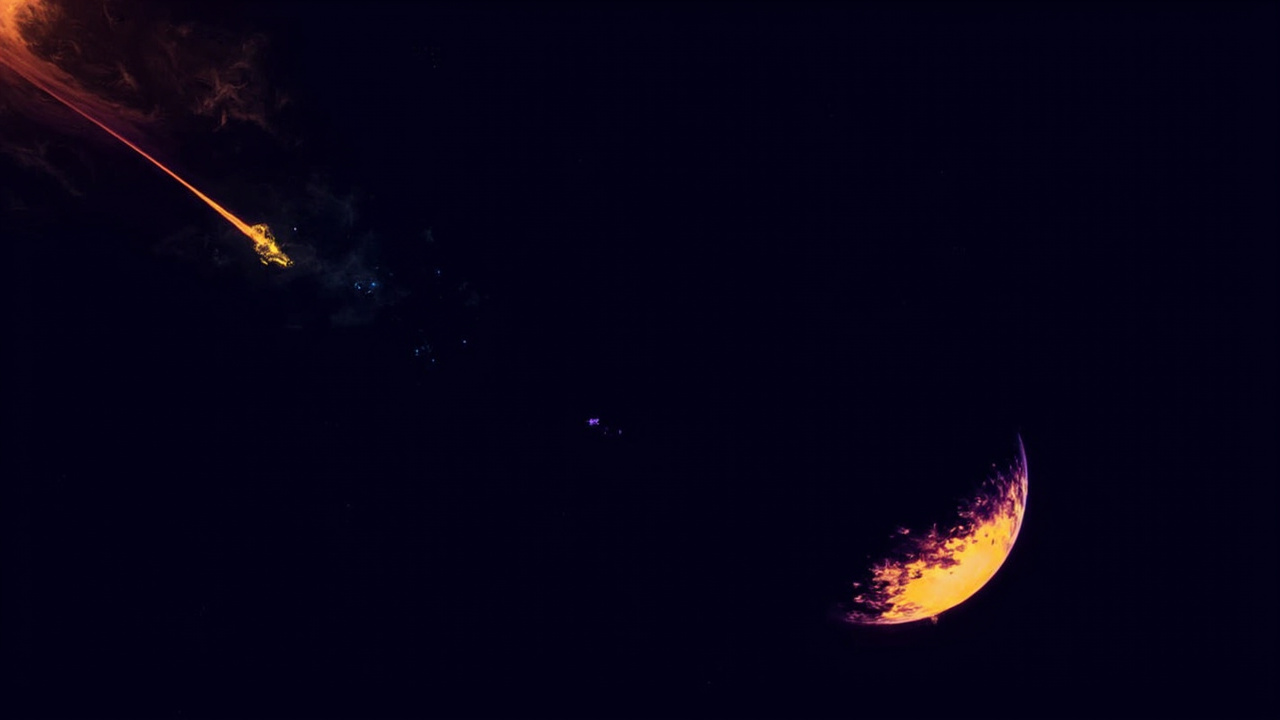
Okay, I need you to picture this with me.
Imagine a moon drifting through the absolute darkness of interstellar space. No sun. No starlight. Just the cold void stretching out forever in every direction. You would think nothing could survive there, right? Everything we know about life seems to require at least some warmth from a star.
But here's the thing — maybe we're missing something big.
A team of researchers from Munich just published a study that made my jaw drop. They found that moons orbiting rogue planets (planets that got booted out of their solar systems and now wander the galaxy alone) could potentially stay habitable for up to 4.3 billion years. That's longer than Earth has existed. Longer than dinosaurs. Longer than basically everything.
So How Does This Even Work?
Here's where it gets cool. When a giant planet gets flung out of its system, it sometimes keeps its moons. These moons don't just calmly drift along — their orbits get completely scrambled. They end up traveling in stretched-out, elliptical paths around their planet.
As these moons swing closer to their planet and then swing away, something interesting happens. The planet's gravity literally squeezes and stretches the moon over and over again. This constant flexing creates friction inside the moon, generating heat. Scientists call this "tidal heating," and it could be enough to keep water flowing beneath the surface.
But here's the catch — in the freezing darkness of interstellar space, that heat would escape into the vacuum pretty quickly unless something trapped it.
The Hydrogen Blanket Solution
Previous research suggested that carbon dioxide atmospheres might work, but there's a problem: carbon dioxide freezes at extremely cold temperatures. In the brutal environment around a rogue planet, CO2 would basically condense into dry ice and stop helping.
The new study looked at something different — thick hydrogen atmospheres.
Now, hydrogen is weird. Normally, it lets heat radiation pass right through it. But under high pressure, something special happens. Hydrogen molecules start colliding with each other in ways that actually trap thermal energy. It's like a blanket made of invisible gas, keeping warmth locked in.
And here's the beautiful part: hydrogen doesn't freeze until temperatures get absurdly low. It stays gaseous even in conditions that would solidify other gases. So a hydrogen-rich atmosphere could act as a heat-retaining shell for billions of years.
This Changes Everything (Again)
The researchers also made an observation that stuck with me. They point out that early Earth might have had similar conditions. Before our atmosphere stabilized, asteroid impacts could have delivered massive amounts of hydrogen. For a period, our planet might have had a hydrogen-rich climate — and we all know what eventually happened on Earth.
Life. It showed up.
The tidal forces don't just create heat, either. All that constant stretching and squeezing creates wet-dry cycles on the moon's surface. Water evaporates, then condenses, then evaporates again. Scientists believe these cycles are crucial for building the complex molecules that life needs to get started.
Are We Alone? The Numbers Say Maybe Not
Here's what really gets me. Astronomers think rogue planets might be incredibly common. Some estimates suggest there could be as many wandering planets as there are stars in the Milky Way. Trillions upon trillions of worlds, just drifting through the dark.
And if even some of those rogue planets have moons — and many probably do — we're talking about potential habitats scattered throughout the entire galaxy. Places where life could arise and persist for billions of years, completely independent of any star.
The search for alien life has always focused on the "Goldilocks zone" — the distance from a star where temperatures are just right. This research suggests we might need to expand our thinking. Habitable worlds might not need sunlight at all.
I don't know about you, but I find that both terrifying and wonderful at the same time. The universe suddenly feels much bigger and much warmer than it did this morning.
Source: ScienceDaily