
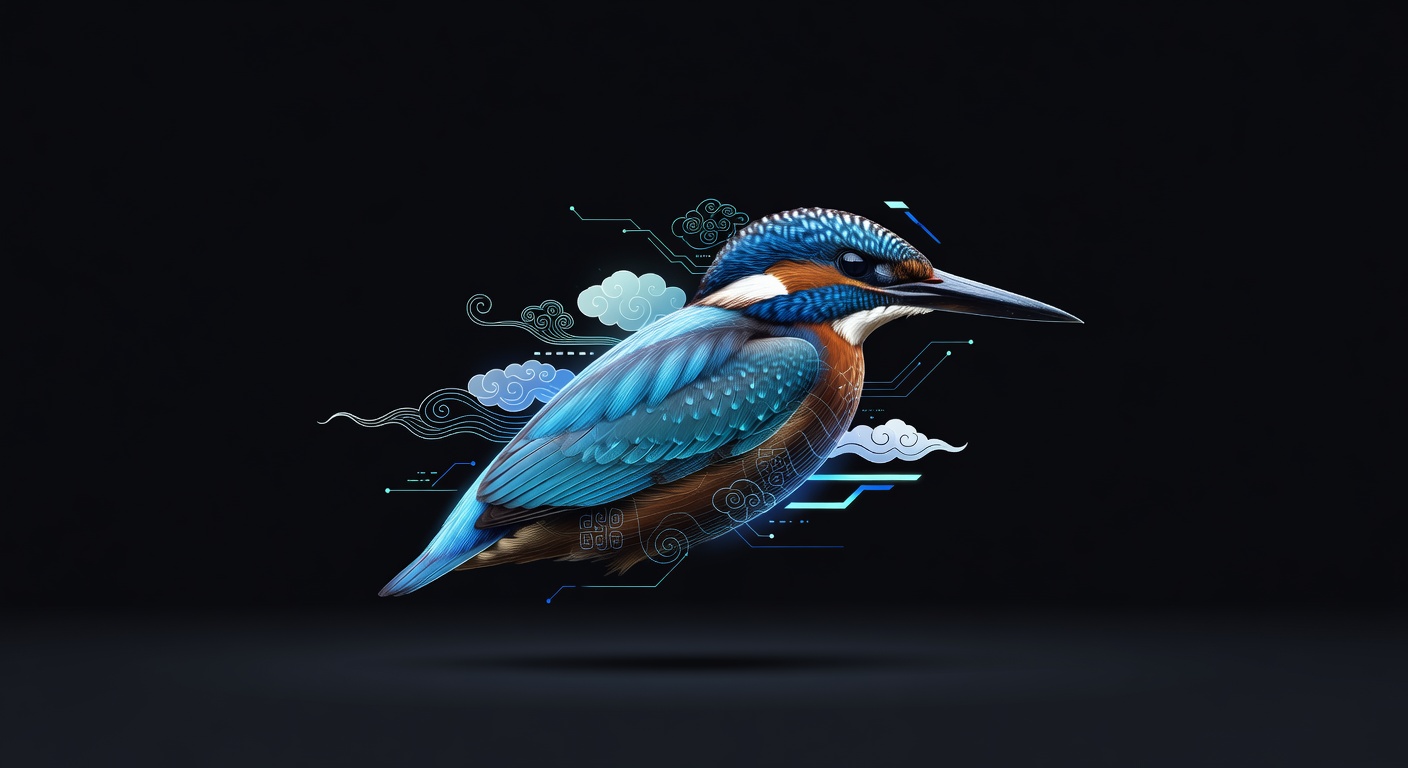
X-Rays Unlock the Stunning Secrets of Kingfisher Feathers and Ancient Chinese Art
Imagine a bird whose feathers shimmer with an electric blue that's not from pigment, but from pure physics. Kingfishers, those jewel-toned divers of rivers and streams, have long captivated artists and scientists alike. Now, cutting-edge X-ray imaging has peeled back the layers of these feathers to reveal their hidden architecture in jaw-dropping detail—bridging biology, physics, and a millennia-old Chinese craft.
The Iridescent Magic of Kingfisher Feathers
Kingfisher feathers aren't blue because of dye or melanin like most bird plumage. Instead, their vivid color emerges from structural coloration, a phenomenon where light interacts with nanoscale features to produce hues that shift with the angle of view. Traditional microscopes could only hint at this, but researchers turned to synchrotron X-ray ptychography—a high-resolution technique using intense X-ray beams—to capture images at resolutions finer than 15 nanometers.
What they found? A marvel of natural nanotechnology. The feathers' barbules (tiny branches off the main feather shaft) feature a spongy keratin matrix riddled with air pockets and melanin rods. These create a multilayer reflector, bending and amplifying blue wavelengths of light while scattering others. It's like a biological Bragg mirror, precisely tuned by evolution for camouflage, mating displays, and perhaps even UV signaling invisible to our eyes.
This isn't just pretty—it's efficient. The structure allows kingfishers to flash brilliant blues without the weight or metabolic cost of pigments, a trick that's inspired tech like anti-counterfeit holograms and energy-efficient displays.
Tian-Tsui: Feathers Fit for Emperors
Fast-forward to ancient China, where kingfisher feathers weren't just admired—they were art. The technique known as tian-tsui (literally "dotting with kingfisher feathers") flourished from the Ming Dynasty (1368–1644) through the Qing era. Artisans meticulously plucked the iridescent blue feathers from Common Kingfishers (Alcedo atthis), glued them onto gold or silver bases, and assembled hairpins, headdresses, and jewelry for imperial courts.
These pieces glowed with otherworldly brilliance, symbolizing status and beauty. But overharvesting decimated kingfisher populations, and the craft faded with the Qing collapse in 1911. Today, surviving artifacts in museums like the Palace Museum in Beijing offer rare glimpses, but their feather structures had never been studied non-destructively—until now.
X-Rays Meet History: A Perfect Match
The research team, led by scientists from the European Synchrotron Radiation Facility (ESRF) and others, scanned actual tian-tsui artifacts alongside modern kingfisher feathers. The X-rays pierced through without damage, confirming the feathers' nanoscale secrets remain intact even after centuries.
Key findings:
- Preserved Perfection: Historical feathers showed minimal degradation, with melanin rods still forming perfect light-trapping lattices.
- Artisan Precision: Glue residues revealed how makers selected only the bluest barbules, enhancing the effect.
- Conservation Insights: Understanding the structure helps museums prevent fading from light exposure or humidity.
This work isn't abstract—it's a lifeline for cultural preservation. By decoding the physics, conservators can now tailor display conditions to protect these treasures.
Why This Matters Beyond Birds and Baubles
Kingfisher feathers exemplify biomimicry, where nature's designs solve human problems. Similar nanostructures appear in butterfly wings and peacock tails, fueling innovations in optics, sensors, and sustainable materials. For tian-tsui, it's a revival story: modern 3D printing and synthetic nanostructures could recreate the glow ethically, sans endangered birds.
As one researcher put it, "We've X-rayed the blueprint of beauty." In a world racing toward lab-grown wonders, this reminds us that evolution was the ultimate engineer.
What do you think—should we bring back tian-tsui with synthetic feathers? Drop your thoughts in the comments!
Source: Ars Technica