
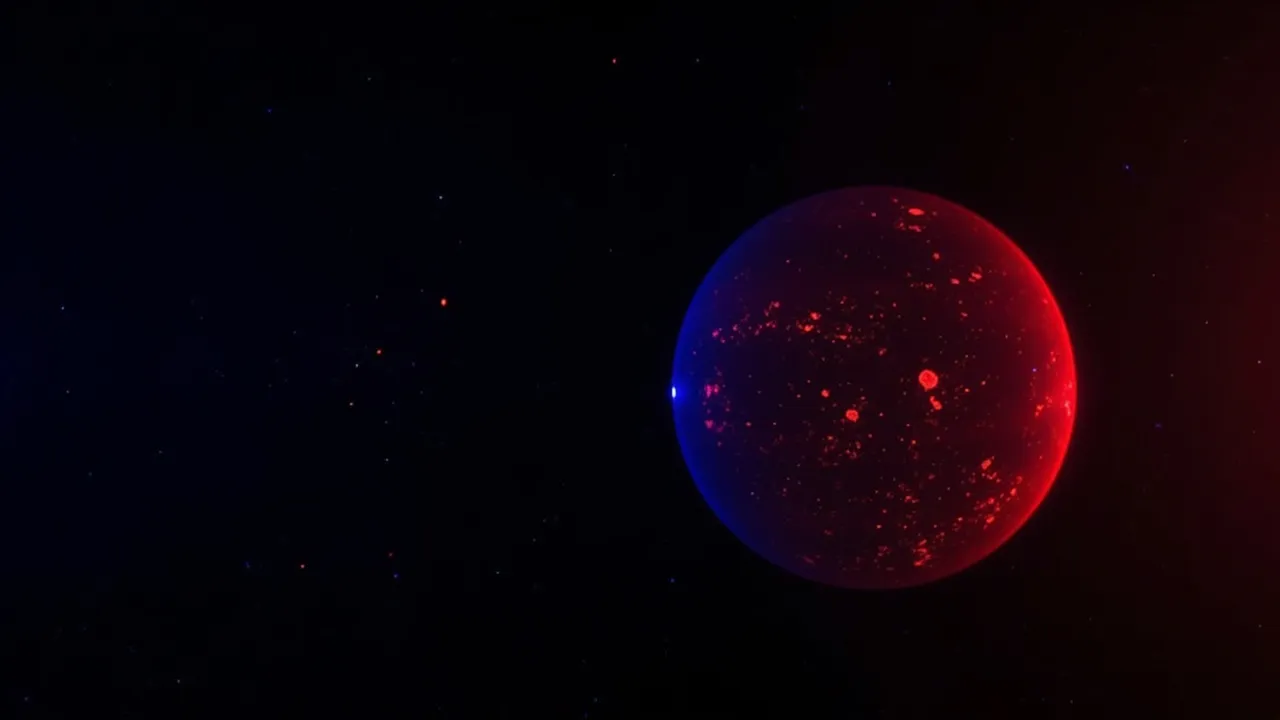
Okay, I need you to picture something with me. Imagine you're a star, just chilling out in space for a few billion years, when suddenly — chomp — you accidentally swallow one of your own planets. Sounds dramatic, right? Well, astronomers just caught a star doing exactly that, and the clues it left behind are absolutely fascinating.
A Cosmic Crime Scene
Meet TOI-5882, a star located about 1,300 light-years away from us. Researchers at the University of Michigan, led by grad student Brooke Kotten, were studying this star when they noticed something strange: it has way more lithium than it should. And that observation has detectives excited for good reason.
"You are what you eat, right?" Kotten said. "We know that there's much more lithium in planetary material than there is in stars. So if a star eats a planet, it's going to take on a bunch of lithium."
Think of it like this — if you suddenly started drinking a lot more orange juice, your body would have way more vitamin C than normal. The star's lithium levels are essentially telling us it snacked on something planetary, not stellar.
The Problem With Catching Stars in the Act
Here's the thing about planetary consumption: it happens incredibly fast on cosmic timescales. We're talking days or weeks, which is basically the blink of an eye when you're dealing with objects billions of years old. So astronomers can't just watch a star in the act of eating a planet.
Instead, they're like forensic scientists examining a crime scene after the fact. They look for chemical traces, unusual signatures, anything that tells the story of what happened.
"That's what makes this field so exciting," Kotten noted. "You really are solving a mystery... We can't just watch the crime happen, so we have to work with all the clues we're given to figure out whodunit."
Honestly, I love this metaphor. Space is basically one giant murder mystery, except the victim is a planet and the culprit is the star that was supposed to protect it.
The Plot Twist: An Accomplice in the Case?
Now here's where things get really interesting. TOI-5882 hasn't expanded enough yet for its size alone to explain how it could have swallowed a whole planet. Stars typically grow huge in their old age (more on that in a second), but this one is still relatively modest in size.
So what happened? The researchers think TOI-5882 might have had help. There's a massive object orbiting this star — more than 20 times the mass of Jupiter — but it's not quite big enough to become a true star itself. Astronomers call these "brown dwarfs," and this one might have gravitational disrupted the missing planet's orbit, sending it spiraling into the star's embrace.
It's like the brown dwarf was the getaway driver while the star did the actual swallowing. Suspicious, right?
Our Own Uncomfortable Future
Now for the slightly unsettling part. Our own solar system is expected to experience a similar fate, just on a much longer timeline. In about five billion years, our sun will reach the end of its life and expand into what's called a red giant. As it grows, it will engulf Mercury, Venus, and possibly Earth.
Five billion years sounds like a lot, and it is — humanity will almost certainly be long gone by then, one way or another. But still, there's something both humbling and a little spooky about knowing that our home planet has an expiration date written into the fundamental physics of our solar system.
On the bright side, we won't be around to witness it. Silver linings!
Reading the Chemical Fingerprints
What I find most remarkable about this discovery is how astronomers actually figured it out. They used a technique called spectroscopy — basically analyzing the light coming from the star to determine what chemicals are present. Different elements leave distinctive signatures in starlight, like fingerprints at a crime scene.
The team compared TOI-5882 against 62 similar stars to make sure its lithium levels were genuinely unusual. The result? The star is so lithium-rich it's off the charts — at least in the 97th percentile no matter how you slice the data.
"The fact that we can look at a star 1,300 light-years away and say with confidence, 'This star has more lithium than you would expect,' is a testament to both the precision of modern instrumentation and the hard interpretive work that goes into making sense of that signal," said researcher Melinda Soares-Furtado.
Based on the lithium levels, they estimate the swallowed planet was somewhere between a couple of Earth masses and roughly the mass of Neptune. Not exactly a light snack!
Why This Matters
Beyond the sheer cool factor of catching a star committing planetary homicide, understanding these engulfment events helps astronomers learn how often they happen and what circumstances trigger them. It's all part of building a bigger picture of how planetary systems evolve — and sometimes fail.
Plus, there's something deeply satisfying about turning abstract cosmic phenomena into a detective story. The universe is full of mysteries we can't directly witness, so we have to get creative about reading the clues left behind.
I don't know about you, but I'll never look at our sun the same way again. Just a friendly neighborhood star, peacefully burning hydrogen... and occasionally snacking on its children. Normal behavior for the cosmos, really.