
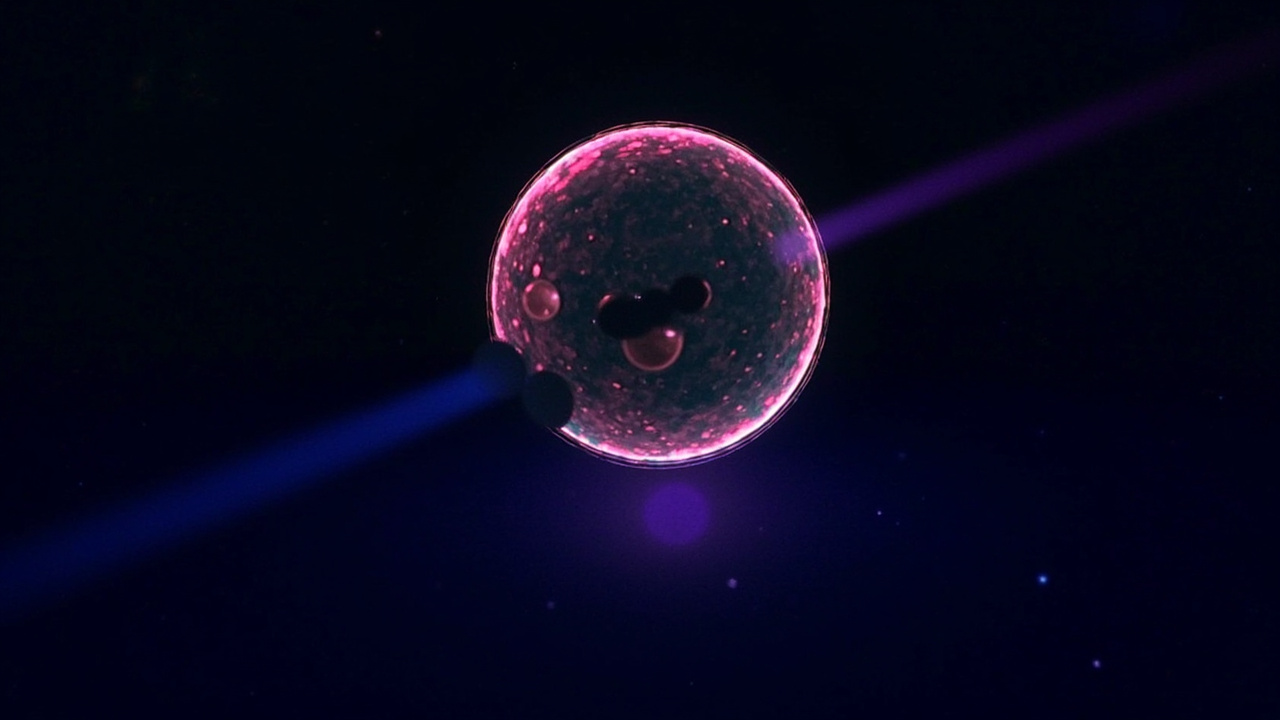
So here's something wild that keeps me up at night: you are, quite literally, glowing.
Not metaphorically glowing like when someone says you have good energy or radiate positivity. I mean your body is literally emitting photons—tiny packets of light—right now, as you read this. Every single cell in your body is doing this quietly, constantly, and we have barely any idea why.
I stumbled across this concept recently and genuinely couldn't stop thinking about it. It turns out there's an entire branch of science dedicated to studying these faint emissions, and honestly? The more I learned, the more it felt like we were peeking behind the curtain of life itself.
The Scientist Who Got Locked in a Dark Room
Picture this: you're a young grad student, and your big research project involves sitting in complete darkness. Not "lights off, I can kind of see" darkness. We're talking six inches of copper shielding around you, a specially built room designed to block every single photon from escaping. You can't see your hands in front of your face.
Why would anyone subject themselves to this?
Because this scientist was trying to detect something that shouldn't exist—at least according to everything we thought we knew about biology. They wanted to measure the light coming from living cells. Just cells in a dish. Skin cancer cells, specifically.
The tool they used is called a photomultiplier tube, and it's absurdly sensitive. The kind of instrument astronomers use to detect light from stars millions of light-years away. If you're trying to pick up the glow of a single cell from across the room, this is basically your only shot.
And here's the thing: every little thing can mess you up. A tiny gap in a cable. A crack in the ceiling letting in light from upstairs. The warmth of an electronic component. Even the detector itself can throw off readings. So much of the work isn't about finding the photons—it's about proving they actually came from the cells and not some random interference.
But then, something magical happened. The signal appeared.
The cells were flashing. Tiny bursts of light. Not a firefly glow, not anything visible to the naked eye, but measurable spikes of activity. And here's what made this researcher nearly fall out of their chair: the light patterns from cancerous cells looked different from healthy cells.
Living tissues may carry information we don't yet know how to read.
This was over 11 years ago. That scientist still can't stop thinking about it.
Wait, People Have Known About This for Almost 100 Years?
Here's where it gets really interesting. This isn't brand new science. Almost a century ago, a scientist named Alexander Gurwitsch was doing experiments with onion roots—yes, the vegetable—and noticed something bizarre. When he pointed one onion root toward another (but didn't let them touch), the second root seemed to grow faster. His conclusion? The first root was emitting some kind of radiation that stimulated cell division in its neighbor.
He called it "mitogenetic radiation."
The scientific community basically laughed at him. For decades, this idea was dismissed as fringe science, unworthy of serious attention. But a small, stubborn group of researchers kept digging. And here's the thing about science: eventually, the evidence becomes impossible to ignore.
Today, these emissions have a more respectable name: biophotons or ultraweak photon emissions. And they're not just a quirky footnote in biology anymore. They're becoming one of the most fascinating open questions in the entire field.
So Why Is Life Shooting Out Light?
This is where things get genuinely philosophical.
We know that biophotons are physical products of normal chemical reactions. When your cells do their thing—metabolizing, processing oxygen, running their mitochondrial machinery—they produce these faint photons as a byproduct. It's a little bit like how your car engine gives off heat while running.
But here's the billion-dollar question: is that all it is?
Some scientists think biophotons are nothing more than metabolic exhaust. Interesting to measure, maybe, but not carrying any real information.
Others think we're looking at something much bigger. What if these photons are signals? What if cells use this faint light to communicate with each other? To coordinate responses to stress, damage, or disease? What if this is an entirely hidden language that biology has been speaking all along, and we're only now learning to eavesdrop?
And the most exciting possibility—what if understanding this could help us detect disease earlier, or even develop new treatments?
Why This Matters for Medicine
Here's where my mind really starts racing.
If cancer cells and healthy cells emit different light patterns, we're potentially looking at a whole new way to detect disease. Not invasive biopsies, not expensive scans. Maybe someday, a simple light sensor could pick up on what your cells are telling you.
But we're not there yet. The field has had a rough history. Biophoton research has gone through cycles of excitement and total rejection. Too many claims couldn't be proven, too many experiments couldn't be replicated. The tools weren't good enough, the methodology was questionable in too many studies.
That is finally changing, though. Better photon sensors, more sophisticated analysis techniques, and researchers coming at the problem from different angles—biophysics, quantum biology, even neuroscience—are giving this field new life.
The Mystery That's Keeping Scientists Up at Night
There's still a major challenge, and I think it's worth mentioning because it shows just how tricky this research is.
Not all faint biological light is the same. Some of it is genuine—cells actually producing photons from the inside. But some of it is something called "delayed luminescence," which is basically the cell absorbing light from somewhere else (like from the sun on your skin) and then re-emitting it later.
Telling these two apart? Extremely difficult.
So before we can answer the big questions—why does life emit light? What is it saying?—scientists first have to make sure they're actually measuring what they think they're measuring.
The Takeaway
I don't know about you, but I find this genuinely humbling.
We've mapped the human genome. We've seen black holes at the center of galaxies. We've split atoms and sequenced ancient DNA. And yet, there's still something this fundamental happening inside every cell of your body that we barely understand.
You're glowing right now. Your 37 trillion cells are each sending out tiny messages into the void, and we have no idea what they're saying.
But we're finally starting to listen.
And personally? I think that's pretty incredible.
Source: Popular Mechanics - Every Cell in Your Body Glows. That Light Could Unlock Extraordinary Insights About Life Itself