
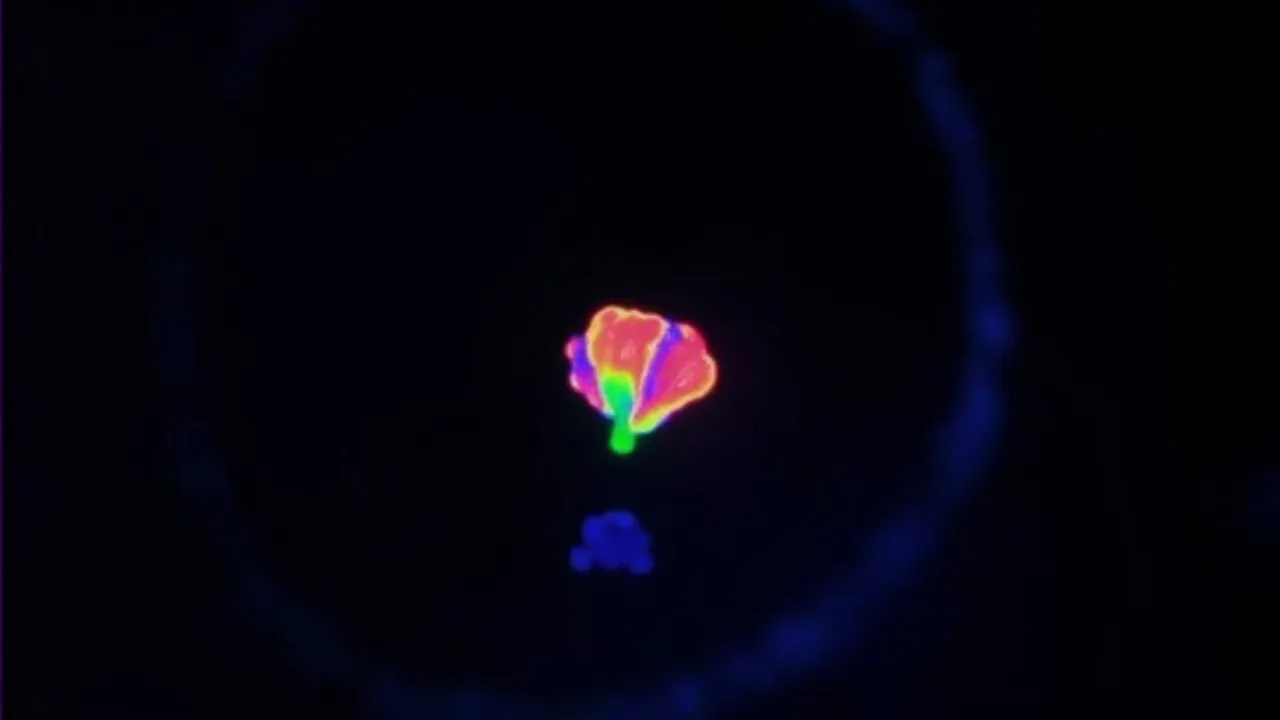
That Split Second When Seeing Gets Weird
Here's something wild: right now, the visual information hitting your eyes is being processed by different specialized regions of your brain — all working simultaneously. And here's the thing — they don't always agree.
Think about those moments when something looks a little off. Maybe a shadow briefly resembles a face. Or you're driving and a road sign looks like something else for just a heartbeat. Your brain is constantly dealing with these little visual hiccups.
But how does it sort out the confusion so quickly? New research published in Nature Neuroscience just revealed something pretty remarkable about how your brain handles these disagreements.
The Brain's Internal Debate Team
Scientists at Cold Spring Harbor Laboratory, working with researchers at Cambridge and University College London, wanted to understand what happens when different parts of your visual system see things differently.
Here's what they focused on: two neighboring regions in the brain's visual cortex. One's called V1 (the primary visual cortex), and the other is LM (the lateromedial visual area). These two regions are in constant conversation with each other — it's not a one-way stream of information. They're always comparing notes.
The researchers trained mice to distinguish between visual patterns tilted in different directions, then temporarily "turned off" one region or the other to see how the other area would cope. They also built an artificial neural network model to test what might happen under different scenarios.
The "Consensus Building" Discovery
Here's where it gets really interesting. The team found that when both brain regions agreed on what they were seeing, that shared signal lasted longer — it stuck around. But when the regions disagreed? The conflicting information disappeared within a fraction of a second.
The researchers call this process "consensus building." Essentially, your brain is running a tiny internal debate, and it has a built-in way of filtering out the noise until it reaches agreement.
Lead researcher Mitra Javadzadeh put it this way: "We are trying to understand how you can have such a high level of specialization between these different blocks, yet always have a consistent holistic outcome."
And honestly? That's the right question. We tend to think of our experience as unified and seamless, but underneath that smooth surface, there's a whole lot of negotiation happening.
What This Means for Understanding the Brain
This research is part of a bigger puzzle — figuring out how the brain combines information from specialized regions into a single, coherent picture of the world. The fact that this "consensus building" mechanism exists suggests the brain has elegant solutions for handling conflicting information.
But here's the really thought-provoking part: this might not be limited to just vision. The researchers are now investigating whether the same process works across the entire neocortex — the brain's outer layer responsible for higher-order thinking.
Think about it: when what you see contradicts what you hear, does your brain use the same kind of consensus-building strategy to reconcile those signals? That's a fascinating possibility.
The Bigger Picture
Understanding this process could help scientists grasp what happens when different brain regions fail to reach consensus — which might play a role in certain neurological conditions or perceptual disturbances.
And get this: the implications might extend beyond neuroscience. The same principles could help researchers develop artificial intelligence systems that handle conflicting streams of information more gracefully. After all, if our brains have figured out elegant ways to resolve disagreements between different processing units, maybe AI could learn something from that.
Javadzadeh asks: "While we understand individual building blocks of the brain, what is the glue that puts them together?"
That question really gets at the heart of it. We know so much about individual neurons, individual regions. But the magic happens in how they work together. And this research is a step toward finally understanding how all those specialized parts come together to create the unified experience of seeing — and being — you.
So next time you look at something and it just makes sense, remember: there's a whole democratic process happening in your brain right now, and somehow, incredibly, it all comes together into one coherent picture.