
The Energy Problem Nobody Talks About
Let's be honest—we're obsessed with how smart AI is getting. ChatGPT can write essays, image generators can create art, language models can do basically anything. But here's the thing nobody mentions at dinner parties: AI is absolutely terrible at being efficient.
Your brain? It's a biological supercomputer running on roughly 20 watts of power. That's less than a standard lightbulb. Meanwhile, the servers powering modern AI systems are guzzling millions of watts and consuming insane amounts of water to keep from overheating. It's honestly embarrassing when you think about it.
This massive gap between biological brains and artificial intelligence has been nagging at scientists for decades. And finally, someone's doing something about it.
Meet the Artificial Neurons
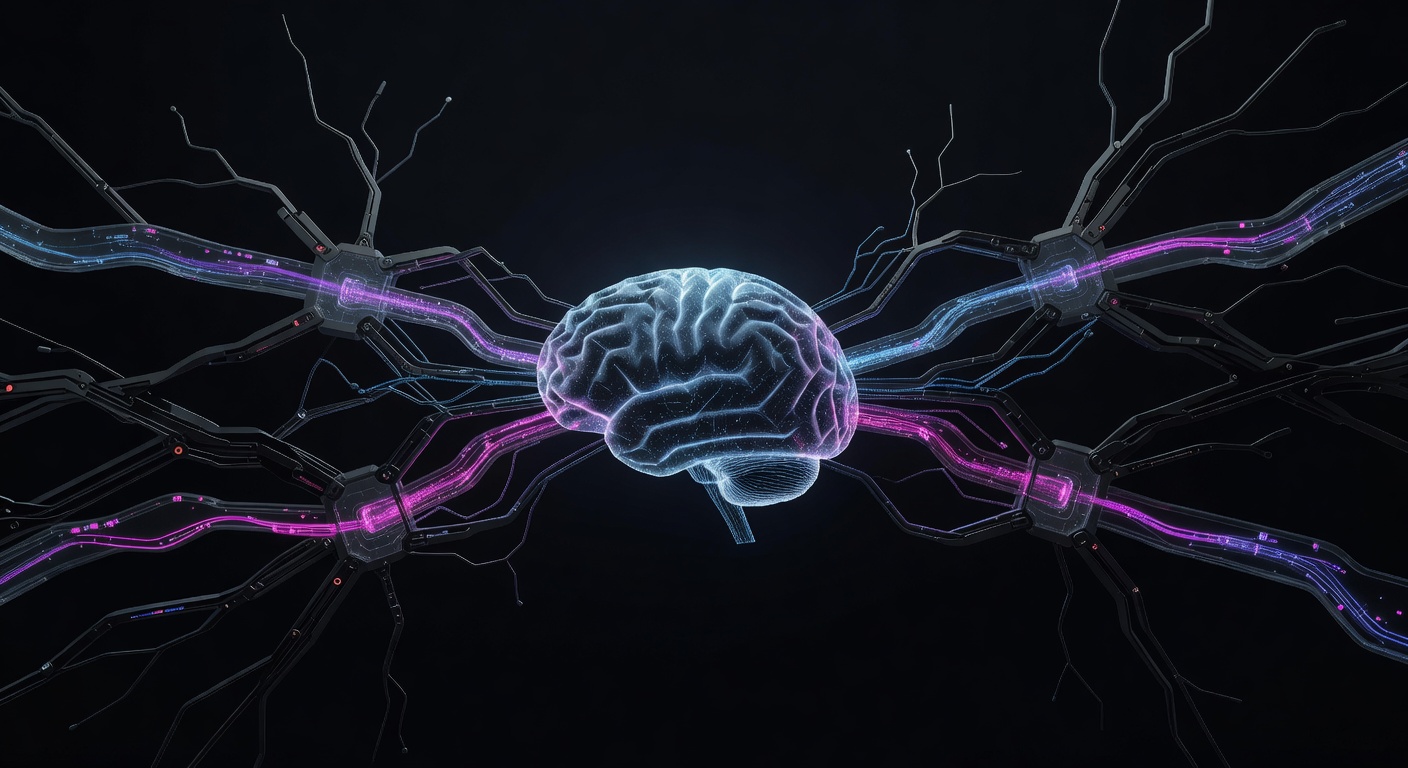
Researchers at Northwestern University just published a study that's genuinely exciting. They've created artificial neurons—yes, actual fake brain cells—that can talk to real ones. I know, it sounds like sci-fi, but it's happening.
The team, led by Mark Hersam, used a technique called aerosol jet printing (think of it like an ultra-precise spray painter for electronics) to build these artificial neurons. They used materials you might recognize—graphene and molybdenum disulfide—combined in a way that mimics how real neurons actually work.
Here's where it gets clever: they didn't fully remove the polymer substrate like other researchers have tried. Instead, they partially decomposed it. When you run electricity through it, the polymer breaks down further in specific spots, creating tiny conductive pathways. This is what makes it behave like an actual neuron instead of just a dumb electronic component.
The Real Test: Can They Actually Talk?
The proof is in the pudding, right? So the team did something wild—they connected their artificial neurons to actual mouse brain tissue and watched what happened.
And it worked.
The artificial neurons fired in patterns that matched real biological signals. Better yet, they actually triggered activity in the living brain cells around them. This wasn't just electrical noise being mistaken for success—it was genuine communication between silicon-based and biology-based systems.
That's huge.
Why This Matters More Than You Think
Most people hear "artificial neurons" and their eyes glaze over. But think about what this means in practical terms:
AI is becoming unsustainable. Training modern AI models requires enormous amounts of data and energy. The environmental cost is real, and it's only getting worse as we push for smarter systems. If we could build AI that operates even close to brain-like efficiency, we'd solve multiple problems at once—lower energy bills, less environmental damage, and faster processing.
The brain is the ultimate template. Why keep trying to reinvent the wheel? Your brain literally does everything AI is trying to do, but in a way that's unbelievably energy-efficient. It can learn, adapt, form memories, and handle complex decision-making on a power budget that would make any data center engineer weep.
What Comes Next?
Here's the reality check: this is early-stage work. We're not building artificial brains tomorrow. The researchers still need to figure out how to create artificial synapses—the connections between neurons that let information flow. That's the "cerebral mortar" that glues everything together.
But this study proves the foundation is solid. We can create artificial neurons that:
- Respond on the right timescale (they're not too slow or absurdly fast)
- Have the correct spike pattern to communicate with real neurons
- Behave flexibly like biological neurons instead of rigid silicon components
The Bigger Picture
What's really interesting here is the shift in thinking. For years, we've approached AI like it's a completely separate domain from biology. We build faster computers, write better algorithms, throw more data at the problem. But maybe that's backward. Maybe the answer isn't to make machines more like brains through pure software—it's to actually use biological principles in the hardware itself.
That's what makes this work so compelling. It's not some distant future fantasy. It's researchers taking something that works incredibly well in nature and figuring out how to recreate it with materials we can actually manufacture and scale.
The dream of brain-inspired computing is finally moving from "someday maybe" to "we're actively building it right now."
That's worth paying attention to.