
Nature's Secret Math Class
You know that feeling when you find a hidden pattern in something random? Like seeing shapes in clouds or noticing that your coffee stain looks like a map of Europe? Scientists have a fancy name for this: apophenia. But here's the thing—sometimes those patterns we find aren't actually random at all. Sometimes nature has been running a masterclass in geometry the whole time, and we're only just now catching up.
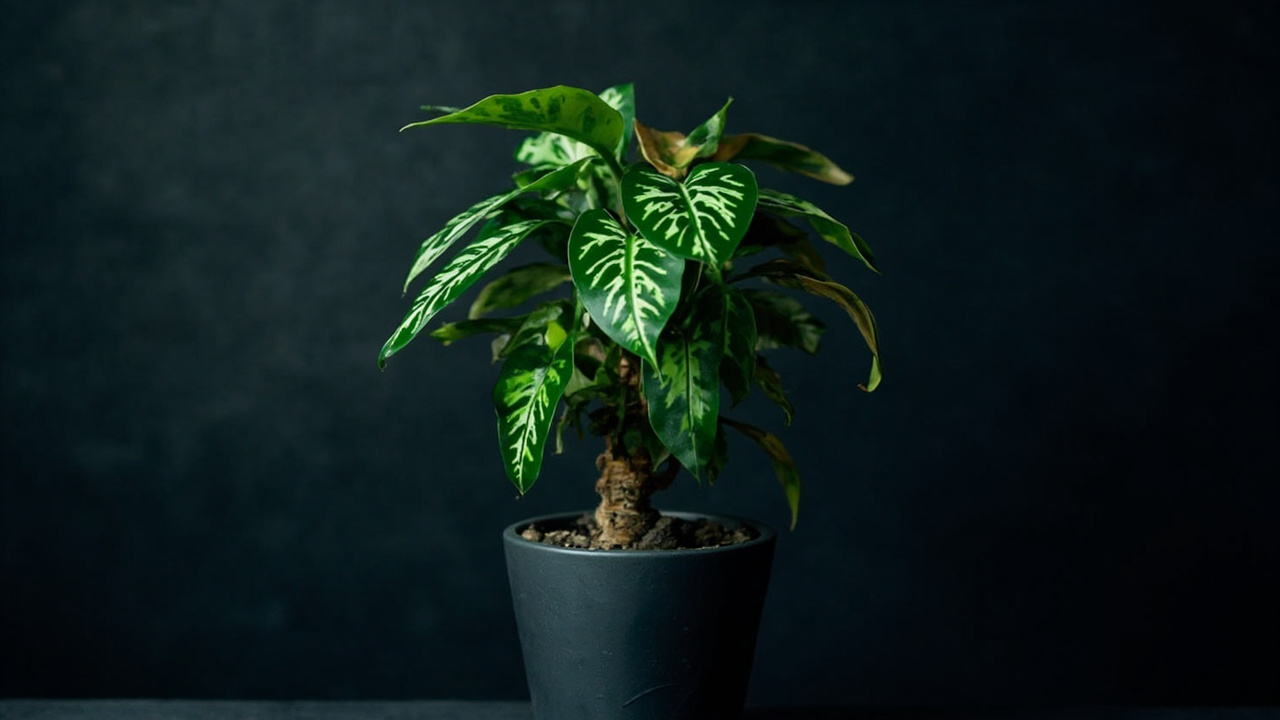
This is exactly what happened with the humble Chinese money plant, a houseplant so popular it's basically the sourdough starter of the plant world. Someone gave you one as a gift? Yeah, everyone gets one of these eventually. But it turns out, these unassuming green companions are way more mathematically sophisticated than we realized.
Wait, What's a Voronoi Diagram?
Let me break this down without making your brain hurt. Imagine you're organizing school districts in a city. You want each neighborhood to be assigned to the school that's closest to them, right? That creates natural regions or zones—and that's basically a Voronoi diagram. It's a way of dividing up space so that every point in a region is closer to one central point than any other central point.
Sounds complicated, but it's super practical. City planners use it. Computer scientists use it for network design. It's one of those elegant mathematical concepts that keeps showing up everywhere because it's just... efficient.
The wild part? Nature figured this out millions of years ago.
The Plant That Cracks the Code
Researchers at Cold Spring Harbor Laboratory, including associate professor Saket Navlakha, decided to take a really close look at the Chinese money plant's leaves. And I mean really close. They mapped out all the tiny pores (called hydathodes) and the network of veins looping around them.
What they found was mind-blowing in its simplicity: the leaf structure naturally organizes itself into a perfect Voronoi pattern. The veins around each pore create boundaries that divide up the leaf space in exactly the same way mathematicians designed these geometric systems to work.
But here's the kicker—the plant isn't doing trigonometry homework. It's not measuring distances or solving equations. It's just... growing.
The Plant's Hidden Algorithm
This is where it gets really interesting. One of the researchers, Cici Zheng, said something that stuck with me: "Just as humans have to solve problems to survive, the same goes for other organisms. But unlike humans, plants cannot explicitly measure distances!"
So how does the plant do it? Through what the researchers call a "natural algorithm"—basically, a set of biological instructions that play out locally in each cell. The plant cells interact with their neighbors using simple chemical signals and biological rules. Following these local rules, the system as a whole creates this globally organized, mathematically perfect pattern.
It's like thousands of tiny workers following simple instructions and somehow ending up building a perfect architectural masterpiece without any master blueprint.
Why Should You Care?
Honestly? This is one of those discoveries that hits different once you really think about it. We're finding evidence that the universe is fundamentally mathematical, and organisms have evolved to tap into these mathematical principles in surprisingly elegant ways.
For decades, plant biologists were stumped about how leaf veins actually form. They could see the patterns, but nobody could explain the mechanism. This research finally cracks that mystery open. More importantly, it shows that by studying how nature solves problems, we might discover new algorithms and methods for solving our own problems.
Think about the applications: better network designs, more efficient city planning, optimized resource distribution systems. All by studying how a plant arranges its veins.
The Bigger Picture
What I find most fascinating is what this tells us about life itself. Evolution doesn't require consciousness or planning. Life just finds efficient solutions through local rules and interactions. Every organism, from plants to animals, is carrying around solutions to complex mathematical problems encoded in their DNA—solutions they've been perfecting for millions of years.
The next time you water your Chinese money plant, take a closer look at those leaves. You're looking at a living, breathing mathematics textbook. And unlike the one from high school, this one actually grows and cleans your air.
Not bad for a plant you got as a gift, right?