
Your Stale Bread Could Power the Future (And It's Weirder Than You Think)
We've all been there: you buy a loaf of bread with the best intentions, but by the end of the week, half of it has gone stale and moldy. You toss it in the bin and move on with your life. But what if I told you that those breadcrumbs could actually be powering the world someday?
I know, it sounds like something out of a sci-fi novel, but researchers at the University of Edinburgh have actually made it happen. And honestly? It's one of the coolest things I've heard about in a long time.
The Problem We Didn't Know We Had
Before we get to the bread part, let's talk about hydrogenation for a second. I promise it's less boring than it sounds.
Hydrogenation is this chemical process that's everywhere. It's used to make plastics, pharmaceuticals, cosmetics, and all sorts of stuff we use every day. You've probably seen "partially hydrogenated vegetable oil" on food labels—that's what happens when you hydrogenate vegetable oil to make it solid instead of liquid.
The catch? Traditional hydrogenation relies on fossil fuels. A lot of fossil fuels. It's basically one of those industrial processes that's absolutely essential to modern manufacturing, but also a total environmental nightmare. It's like we're stuck between a rock and a hard place—we need the process, but we hate what it does to the planet.
Enter: Bread-Powered Bacteria
Here's where it gets wild. Scientists realized that certain bacteria, specifically E. coli, naturally produce hydrogen gas when they eat organic matter in the absence of oxygen. It's just what they do—kind of like how humans need to eat to survive, bacteria produce hydrogen as part of their own metabolic process.
So Stephen Wallace and his team asked themselves: what if we just... fed them bread? Like, literally breadcrumbs?
And it worked. Not only did it work, but it worked better than expected.
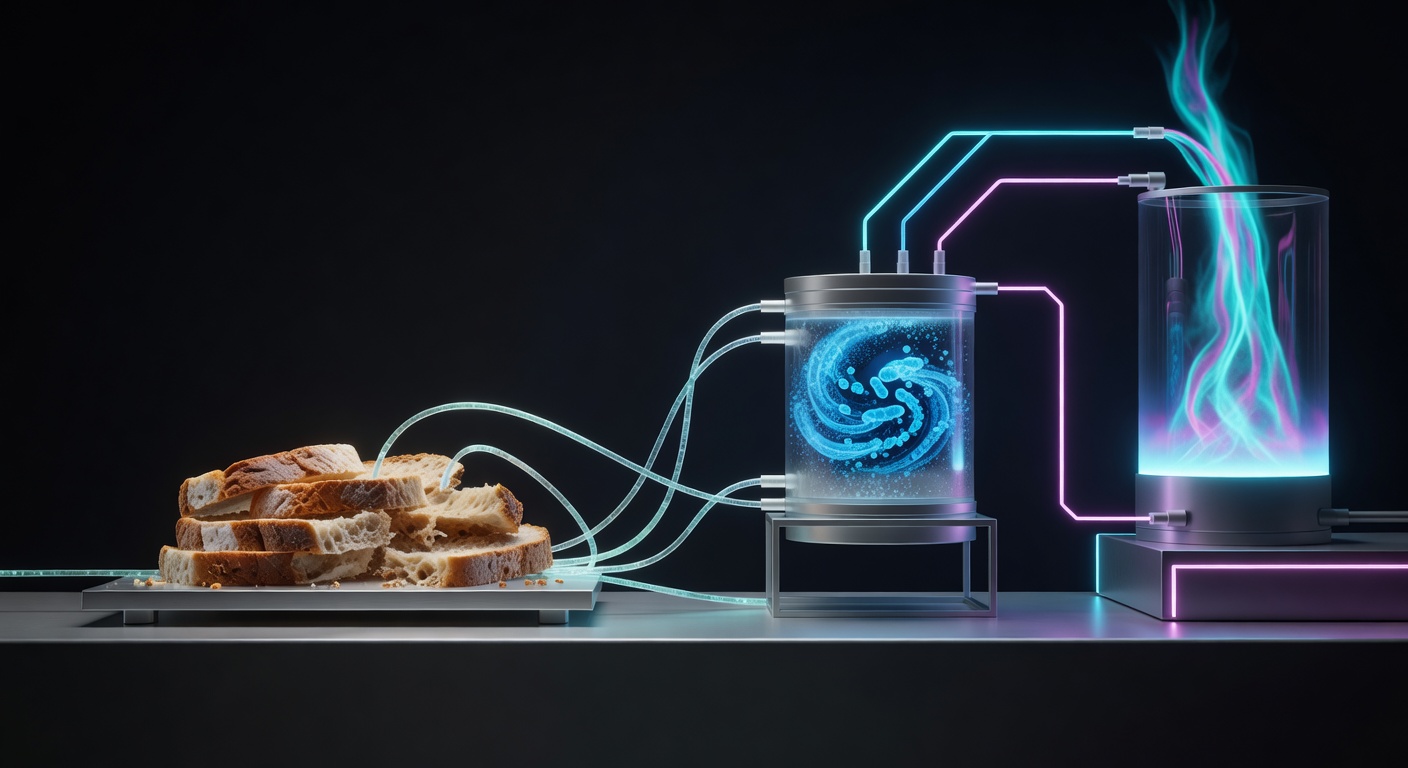
They took regular, unmodified E. coli strains (which is actually important—they didn't need to genetically engineer them into weird Frankenstein bacteria), gave them some breadcrumbs as a food source, added a special catalyst to help along the reaction, and removed the oxygen from the environment. The bacteria started munching on the bread and producing hydrogen gas like little tiny factories.
When they tweaked the bacteria slightly to produce certain metabolites, the hydrogen production went through the roof.
Why This Actually Matters (And It's Not Just Hype)
Okay, so bacteria eating bread is cool and all, but why should you care?
The real magic is in the numbers. When researchers measured the environmental impact of this bread-powered hydrogenation compared to the traditional fossil fuel method, the difference was stunning. We're talking carbon-negative outcomes here—meaning the process actually reduces carbon in the atmosphere rather than adding to it.
And get this: using bread that was already destined for the landfill (instead of growing something specifically to feed the bacteria) cut the emissions so dramatically that researchers think it could genuinely help reverse climate change. Not slow it down—actually reverse it.
That's not hyperbole. That's what their research shows.
The Real-World Applications
This isn't just some cool lab experiment that'll never see the light of day. If this technology scales up, we're talking about potentially transforming how we manufacture:
- Plastics and polymers (think everything from phone cases to car parts)
- Medicines and pharmaceuticals (which require hydrogenation in many synthesis steps)
- Food products (stabilizing oils and fats)
- Cosmetics and personal care items
Basically, any industry that currently relies on hydrogenation could eventually switch over to this bacterial bread method. That's... kind of a lot of industries.
The Reality Check
Now, I should be honest with you: this is still early-stage research. Scientists aren't going to show up at your house tomorrow to collect your moldy bread. The team will need to figure out how to scale this up from laboratory conditions to actual industrial manufacturing, which is always the tricky part.
But here's the thing that gets me excited: the proof of concept is solid. The bacteria work. The bread works. The emissions numbers are real. And unlike some cutting-edge tech that requires rare materials or impossible conditions, this uses bacteria that are easy to work with and bread that's a waste product.
The Bigger Picture
What I love about this research is that it's part of a bigger shift in how we think about manufacturing. Scientists aren't just looking for alternative energy sources anymore—they're looking at waste streams and asking, "What could we actually make from this?"
We've already seen this with things like turning coffee grounds into biofuel or plastic bottles into vanilla flavoring. But the bread-to-hydrogen story feels different because it has the potential to replace something so fundamental to modern manufacturing.
It's a reminder that sometimes the solution to our biggest problems might be sitting right in our kitchen, molding quietly in the breadbox.
Source: https://www.popularmechanics.com/science/energy/a70941788/bread-hydrogen-fuel